Sunday, June 17, 2007

Marco Van Basten


Marco van Basten is one of the greatest players Holland has ever produced. He may even be the second greatest, after Johan Crujiff. Consider the quality of footballers who have come from such a small country over the last 40 years, and van Basten's own stature as a player becomes apparent: Johan Neeskens, Ruud Guillet, Frank Rijkaard, Ronald Koeman, Johhny Rep, Wim Kieft, Denis Bergkamp, Clarence Seedorf, Edgar Davids, Arnold Muhren, Ruud van Nistelrooy, Patrick Kluivert, the deBoer brothers and Arie Haan. Marco van Basten was better than any of them. He was the best goalscorer of his generation, not just in terms of his actual goalscoring record - altough with 276 goals scored in 338 games, that is undeniably impressive -but also in terms of his skill level. I could end this post with just this clip, because it makes my argument perfectly:


That goal was scored in the Final of Euro 88, and it was the goal of the tournament. To strike the ball so perfectly - it arcs right over the keepers head and into the side netting at great pace - from that angle, when it has come from over the shoulder, with a defender bearing down on him, and in such a big game, shows van Basten's class and confidence. But then, he's Dutch, brought to Ajax Amsterdam and their famous football academy from his home in Utrecht in 1981 at the age of 17. Ajax train their youth teams the Dutch way. This means that while they train every day, working on technique and fitness and skill, they are also educated in tactics and the more scientific areas of football. "Total football", the Dutch school of thought from the 1970s, survives today in an updated form - players are brought up able to play in every position, giving them an insight into how that position needs to be played and how it can best be utilised. The result has been a few generations of players who understand what is happening on the pitch, are capable of analyzing why it is happening, and are unafraid of sharing their opinion about it. This has led to the many Dutch squad implosions and walkouts and arguments over the years which have played their part in the fact that Holland has never won the World Cup. Van Basten himself has stated that the most common words in a Dutch dressing room, uttered by every player after a word from the coach, are "Yes, but..."

While it may generate divisions, the Dutch means of developing players also fosters confidence in those players. The Dutch have never been afraid of expressing themselves on the pitch. Indeed, of all the Northern European nations, they undoubtedly play with the most elan and conspicuous skill - it has been part of the football culture of the Netherlands since the 1960s, and all of Holland's great teams and achievements have been based around it, from Crujiff's Ajax and International teams in the 70s to the 88 team of Guillet-Koeman-Rijkaard and van Basten to Louis van Gaal's Ajax in 1995. In the European game, perhaps only Portugal and France have consistently played with a comparably attacking, entertaining style. But the Dutch have done it their way, basing their football rigorously on their own principals and deliberately allowing that to influence the way the game is played all over the country. Players like van Basten are the result. As a striker, he could do it all. He was big and blessed with superb upper body strength, meaning that he could hold the ball up as well as any forward of his generation. He was tall, had a great sense of timing and positioning, and possessed a good leap, meaning that he scored lots of headers:


This outrageous finish, against Real Madrid, is a display of amazing control and power for a header. He manages to put it right in the top corner too:


But unlike many physical target men, he had sublime skill, too, allied with a great agility that was possibly the legacy of his childhood love of gymnastics. He uses both for this goal, somehow managing to clip the post with the shot, leaving the goalkeeper utterly motionless:


He could dribble too, was good with both feet, linked the play skillfully and creatively, and his ability to glide onto through balls was probably his greatest strength. That and the aforementioned confidence, which meant that he was a Big Game player, scoring goals in Finals and key games throughout his successful career. He scored in the European Cup final and the European Championship Final. But then he scored in so many of his games and so many of those goals were classic centre forward play, but he always seemed capable of picking his spot, and crucially, he always made it look so easy, and so simple :


All of those clips demonstrate his supreme elegance - he did everything stylishly. His range of talents and awareness suggested that he might have matured into a playmaker as he aged, but his career was cut short by a recurring injury at the age of 28. Still, his achievements are legion, and awesome. Beginning at Ajax, where he made his debut as a substitute for the legendary Crujiff in 1982, in a moment heavy with symbolism. Of course, he scored. He went on to score 28 goals in 26 matches in the 1983-84 season. Crujiff introduced him to the then-coach of Inter Milan as "the new Crujiff", which is incredibly strong praise from a man who never underestimated his own gifts. In 1986, van Basten won the Golden Boot as Europe's top scorer with 36 goals, a tally which attracted the attention of AC Milan. He moved there in 1987, having scored 128 goals in 143 games for Ajax to help win two Dutch Championships, two Dutch Cups and one Cup Winners Cup.

More trophies would follow at Milan, where he was the tip of the awesome spine of what is one of the indisputably great teams in the last 3 decades of European football. Behind him, Van Basten had the incomparable Franco Baresi at centre back and Ruud Guillit in midfield, alongside the likes of Frank Rijkaard, Roberto Donadoni, Alessandro Costacurta and Paolo Maldini. Milan won the Italian title in his first season, but van Basten missed all but eleven games, troubled by the ankle injury that would ultimately end his career. He was included in the Dutch squad for Euro 88 but was not in the first team.
In that tournament, Holland found themselves in the "Group of Death" alongside England, the USSR and Ireland. Holland lost their first game, 1-0 in a tight struggle against a difficult Soviet team. Van Basten made his impact in the second game for the Dutch, when they faced England, both teams needing a win after losing their first game. He scored a hat-trick and more or less utterly humiliated Tony Adams in the process as the Dutch ran out 3-1 winners. He also made himself undroppable, and justified his continued selection with a late winner against hosts and favourites West Germany in the semi-finals, then that amazing goal in the final.

He maintained this form when the season resumed and he returned to Milan, fit and playing regularly. He scored 19 goals that season, won European footballer of the year, and scored twice in the European Cup Final against Steau Bucharest. The next season he again won European footballer of the year and Milan successfully defended the European Cup, defeating Benfica in the final. His years at Milan are a list of honours and incredible acheivements: in all, he won European Footballer of the year three times, World Player of the year once, was Top scorer in Serie A three times, won two European Cups, 3 Italian titles, two intercontinental cups, two European supercups and three Italian Supercups. In addition he was a crucial part of the Milan team which set a long-standing record for consecutive appearances without defeat (58 games in total) during the 1992-93 season. His goal-scoring record in this era is more impressive for the fact that it was maintained during the richest years of domestic Italian football, when teh worlds great players flocked to Italy and defences were legendarily tight in the best Italian fashion. Few defences were too tight for van Basten, and the Italians nicknamed him "Marco Golo". He was so important to the team that when he fell out with Coach Arrigo Saachi, Milan Owner Berlusconi sacked the coach rather than sell the player. The fact that he quarrelled with a coach as venerable and cerebral as Saachi illustrates that Dutch capacity for opinionated comment, and van Basten's self-assuredness. However, his ankle injury recurred and he underwent a series of operations, none of which was enough to save his career. He returned for the end of the domestic season and played in the European Cup FInal, which Milan lost to Marseille. It would be his last game for the club, and indeed his last game as a Professional Footballer. Recently he has enjoyed some success as Coach of Holland, where his confidence and intelligence seem to have been put to good use, but he is best remembered for the stylish and lethal quality of his striking, particularly in his years at Milan:

Monday, May 14, 2007

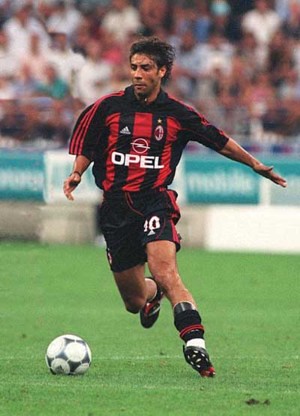
Rui Costa


Rui Costa was perhaps the most old-fashioned, elegant playmaker of his era. But he played in Italy at a time when Serie A had more than its fair share of the world's great playmakers - Zinedine Zidane, Dejan Savicevic, Allessandro Del Piero and Roberto Baggio, among many others, all played against Rui Costa during his time at Fiorentina and AC Milan - and as a result he never quite received the recogniton he deserved. In addition, he was part of Portugal's famous "Golden Generation", alongside the equally talented Luis Figo, meaning that he never even received the acclaim he warranted in his homeland, always having to share the spotlight with his team-mate. But in the late 1990s, if you searched Europe for a player capable of controlling the pace of a game, or of opening up a defence with a dribble or a perfectly placed through-ball, there was really nobody better.

His vision was perhaps his greatest, most unique gift. There is a sequence in the video below highlighting his ability to pick out a forward closing in on goal, often from within the centre circle, with a single, perfectly weighted, precisely-threaded ball between scrambling, panicked defenders. Forwards as celebrated as Gabrielle Batistuta and Andrei Shevchenko both benefitted greatly from this talent. Rui Costa made it look effortless, never seeming rushed in possession and always appearing assured of what he intended to do, he seemed always to have more time than anyone else on the pitch:


That confidence obviously came from his technical virtuousity. His touch was gentle, but he was blessed with the pace and acceleration of a winger when he strode forward with the ball, shedding defenders as he went with shimmys and stepovers. He had the ability to pick out a pass at any moment, but he was just as likely to perform a lollipop or set himself for a shot. So many of the goals in the above video are placed finishes, curlers which he caresses into the corner of the net, mockingly just beyond the grasp of a goalkeeper, his composure marked and admirable. But he was also capable of drilling shots from outside the box:


This stupendous goal for Milan shows a combination of his skills, with a little run to start off, then a blasted curling ball into the top corner from outside the box :


Born Rui Manuel Cesar Costa in Lisbon in 1972, he was spotted at a trial for Benfica, the Lisbon club he supported throughout his childhood, by none other than Eusebio at the age of 10, and spent his teens playing for Benfica's youth teams. In 1990 he was loaned out to AD Fafe for a season, gaining experience of the professional game. Perhaps the greatest experience he gained, however, came from his time spent in the Portugeuse Youth system. Overseen by Carlos Quieroz, that system had produced the team that won the Under-20 world Youth Championship in 1989 in Saudi Arabia. In 1991 the Championships were held in Portugal itself, and a team including Costa, Figo, Fernando Couto, Joao Pinto, Paolo Sousa and Sergio Conceicao beat Brazil in a penalty shootout in the final. Rui Costa took the deciding penalty, watched on television by most of the population of Portugal, and expectations of what this "Golden Generation" would achieve at senior level were stratospheric. Costa was welcomed into the first team at Benfica during the next season by coach Sven Goran Eriksson, playing in his customary role as attacking midfielder. I first saw him play when Benfica beat Arsenal at Highbury in the European Cup in 1994, and he was the oustanding individual. He liked to pick the ball up in central midfield and stride forward with his distinctive busy movement, skinning opponents and evading tackles before laying the ball off. Some players wind up before they strike the ball, you can see them prepare their body in the seconds before they execute the move they intend, their shoulders tigtening slightly, their hips rotating, heads maybe tilting to a certain angle. But Rui Costa struck the ball with fantastic ease - it rolled off his feet, always in his stride, as if he had not even meant to pass it, as if the perfectly placed ball he had just delivered was an accident, a fluke of his pumping sprint. That sprint too - he was deceptively pacy - never looked too strenuous, due to his strange jerky gait. He worked hard, covering lots of ground, working the spaces of midfield, but never tracking back, not making too many tackles, as if he thought defensive duties were beneath one with such extravagant technical gifts. One of his managers at Fiorentina, Claudio Raineiri, was prompted to ask him if all games in Portugal were played on a slope, because he never ran back to defend.

He won a Portugeuse league title and cup at Benfica before he was sold to Fiorentina in 1994. Instantly striking up an understanding with the awesome Batistuta, he remained there for 7 seasons, winning two Italian Cups and constantly being linked with transfers to bigger clubs. But he enjoyed the pace of life in Florence and obviously enjoyed the adoration of the Fiorentina fans, where he and "Batigol" were two very big fish in a relatively small pond. He also enjoyed absolute freedom on the pitch, especially under Turkish coach Fatih Terim in his last season. Terim, realising how important Costa was to the teams attacking style, especially in the absence of Batstuta, who had moved to Roma, told the Portugeuse that he had the freedom of the pitch, he could go anywhere and do anything he chose. When Terim moved to AC Milan in 2001, he brought Costa with him for a fee of 35 Million euros. Here he was instrumental in Milan's European success, helping them to a Champions League victory in 2003. That summer, Milan purchased the young Brazilian Kaka, and he quickly replaced the ageing Rui Costa as the player in the withdrawn role behind Milan's strikers. They are very similar players, and it is a great tribute to Kaka that his contribution was so great that Milan have not missed Costa since he left to return to Benfica in 2006. In those last two seasons at Milan, Costa played rarely, since Milan had a surfeit of playmakers - as well as Costa and Kaka there were Clarence Seedorf and Andrea Pirlo. He is still contracted to Benfica and intends to end his career there, where it started.

The Golden Generation never really lived up to its billing, though they came close. In Euro 96, they were eliminated by eventual finalist the Czech Republic in the quarter-finals, having played some lovely football to get there. However, they never really looked like the finished article, the many individual talents on display not quite blended properly yet. They had been in Ireland's group for the Qualifiers, and I remember being shocked by how fluent and skillful they had seemed when they took us apart, 3-0, in Lisbon. Costa scored a beautiful goal that night, firing a 30 yard screamer into the top corner, and he utterly controlled the game, embarassing our midfield. They seemed to be living up to their billing as "the European Brazil", at least in terms of the flair and skill with which they playe dthe game. They were grouped with European Champions Germany in the qualifiers for the 1998 World Cup, a tournament for which that group would perhaps have been at its peak. During the German tie between the two countries, with Portugal leading, Rui Costa was sent off for taking too long to leave the field, Germany recovered to win the match against 10 men, and they qualified for the tournament at Portugal's expense. Euro 2000 was to be the first tournament at which they showed the true beauty and effectiveness of their football, with Costa orchestrating everything. Their amazing 3-2 win against England in their first game, when they came back from 2-0 down, set the tone. Alongside hosts Holland they were the entertainers of the tournament, playing flowing, attractive attacking football. However they ran into World Champions France in the semi-finals and were eliminated, after a tense, tight contest, by a controversial Golden Goal. Zidane scored with a penalty after Abel Xavier handled in the area, the Portugeuse threw a massive tantrum, but they were out. Worse was to come in the 2002 World Cup in Japan & Korea, where Portugal, in common with other favourites France and Argentina, were dumped out of the tournament in the group phase . After an hour of their first game against the USA, Portugal were 3-0 down, a barely imaginable scoreline. They pulled two goals back, but their campaign never really recovered from that early shock, even though they beat Poland 4-0. They needed a draw against South Korea in the last game to advance to the knock-out phase, but instead had two players sent off and lost to a late goal from Park Ji-Sung.

The Golden Generation had aged, and both Costa and Figo were no longer considered certain starters for Euro 2004, which Portugal hosted. A new generation of stylish Portuguese players led by Cristiano Ronaldo and Simao Sabrosa had emerged, and Brazilian coach Phil Scolari trusted them, loading his squad with players from the Porto team which had just won the Champions League. But Costa still made a worthy contribution, displaying his class when he came off the bench during the quarter-Final clash with England to score this goal:


The final, which Portugal lost to Greece, would prove to be his last match for his country. He is the third most capped Portugeuse player of all time. However, it is for his exploits at club level for which he will be chiefly remembered, certainly at Milan and Benfica, where his talent was rewarded with the tropies it deserved. But especially at Fiorentina, where he played probably the best football of his career before a devoted audience :

Monday, April 2, 2007

Paul McGrath


On 11 June, in the first game of the Italy 1990 World Cup Finals for either country, England played the Republic of Ireland in Cagliari. The game was terrible, like an English Second division match. The players all knew one another too well, their systems and styles cancelled each other out, and both teams were petrified of losing in what looked like being a very tight group. England took the lead with a Gary Lineker goal - the usual tap-in - before Kevin Sheedy equalised with a drive from the edge of the box. Both teams looked like they were content with a draw. The Italian press hated the match and described it as the worst they had seen so far at the finals, with the standard of football shamefully unimaginitive and primitive (Ireland would go on to play a worse game against Egypt a few days later). Both teams would qualify for the last 16, but neither played well in that group stage. Indeed, only two players really stood out at all from either team :Paul Gascoine for England and Paul McGrath for Ireland.

Paul McGrath is a legend in Ireland. As Footballers go, only Roy Keane really compares in terms of public affection. The Irish crowd chant of "Ooh-Ah Paul McGrath" (which Man Utd fans converted to Ooh-Ah Cantona) was best used when Nelson Mandela visited Dublin in the 1990s, only to be greeted with chants of "Ooh-Ah Paul McGrath's Da". The Irish chat show "The Late Late Show", the worlds longest running chat show, devoted one of its weekly programmes entirely to a review of McGrath's career, with appearances by most of the major figures in Irish football history. He has featured on an Irish stamp. I feel like even all these facts don't adequately convey just how worshipped he is. Given the meagre accomplishments in his club career, especially in comparison to other Ireland legends like Keane, Liam Brady, Johnny Giles or even Damien Duff, this may seem strange. But McGrath is probably the greatest defender ever to wear an Ireland shirt, and one of the handful of best players the country has ever had. The Irish football public knew class when it saw it, especially in the 1990s, when much of our football was effective but not especially classy. The way Paul McGrath played football was always classy.

Especially considering the way he lived his life. A functioning alcoholic for much of his career, in his autobiography he describes suicide attempts, black-outs, going AWOL while on Pre-season tours and playing many games drunk. He went missing a couple of times when he should have been playing for Ireland in impotant qualifiers, turning up in small hotels then fleeing from the media. All this only made him more popular in Ireland, where people love a flawed hero. McGrath is obviously a troubled man, and his vulnerability makes it easier to like him. Not only his evident self-destructive streak, but his chronic shyness and the way that he played the last decade of his career plagued with a succession of serious knee injuries only made him seem more heroic. As does his background - the child of an Irishwoman and Nigerian, he was given up for adoption as an infant and spent much of his childhood in a series of Dublin orphanages. Ireland was not remotely multi-cultural until this century, and it must have been difficult to grow up in the 1960s and 70s, mixed-race in working class Dublin. Football would have been a good escape, especially to somebody so naturally athletic and gifted. His first professional club were St Patricks Athletic, where he drew the attention of several English clubs and earned the nickname "The Black Pearl of Inchicore". Manchester United signed him in 1982, and he joined a side with a few Irish players already established, notably Frank Stapleton and Kevin Moran. This eased the shy McGrath's social acceptance, and he gradually eased himself into the first team of a talented United squad.

But it was a United squad destined never to win the biggest prizes. Many blame that fact on the incredible drinking culture at the club at the time. The team was the best in England on its day - routinely beating the dominant Liverpool team of the era - but inconsistent and often appallingly sloppy. Players like McGrath, Moran, Norman Whiteside, Brian Robson and Gordon McQueen would go on marathon midweek benders involving lock-ins and endless pub-crawling. Manager Ron Atkinson turned a blind eye, in the main. And there was some success - that United side won the FA Cup in 1983 and 1985. The Cup Final in 1985 was possibly McGrath's finest hour in a United shirt. Playing an Everton team that was probably the best in Europe at the time, winners of the League and the Cup Winners Cup, United went down to 10 men when McGrath's partner in central defence, Moran, was sent off for a lunging tackle on Peter Reid in the second half. McGrath later said that he partly blamed himself for that, since it was his poor pass that had presented Reid with the ball. He more than redeemed himself in the game, utterly dominating Everton's forward pairing of Andy Gray and Graham Sharp for the rest of the match. McGrath's principal gift was his great ability to read a game. On his good days he seemed to glide around the pitch, never rushed or stressed, always ahead of his opponents, nipping in to steal the ball off a toe, timing his leaps perfectly, always playing simple balls out of defence. He was strong and fast and agile, too, meaning that he could dominate any kind of centre-forward, from a nippy ball technician to a monstrous bruiser. That day he dominated two of them, always first to the ball, never caught out, ever alert and sharp.

Alex Ferguson was less forgiving of that United teams drinking culture, and he quickly broke it up, getting rid of Whiteside and selling McGrath to Aston Villa in 1989. He later said that McGrath was perhaps the most naturally gifted player he had ever managed, which is obviously the highest of praise. After a shaky start, Mcgrath went on to become Villa's bedrock player under first manager Graham Taylor, then Josef Venglos, until he was finally reunited with Atkinson. That Villa team came close to winning the League on a couple of occasions, finishing second behind United in 1993. McGrath was the Fan-favourite, nicknamed "God", and impressed his fellow professionals so much that he was voted Players Player of the Year in the same year. He would go on playing club football at the likes of Derby and Sheffield United until he was 37 years old and had undergone eight separate knee operations. From his first year at Villa he didn't train with the rest of the team because his fragile knees couldn't take the strain. Instead, he did an hour a week on an exercise bike. And yet his performance levels never really seemed to suffer. He got better with age and experience as his understanding of the game developed.


Part of his high standing in Ireland comes from having been a major player during the years of the National Teams greatest success. He played in the 1988 European Championships and the 1990 and 1994 World Cup finals. He excelled in each tournament, in fact. Coach Jack Charlton took his lead from previous manager Eoin Hand by playing McGrath in midfield at first. Ireland had a surfeit of quality centre backs during that era with Moran, David O'Leary, Mark Lawrenson and Mick McCarthy all in contention alongside McGrath. But McGrath had a combination of physical presence and ease upon the ball none of them could really match and so he found himself deployed as a holding player. He excelled there, too, neutralising the threat offered by Ruud Guillit in 1988. By 1994 he had established a new partnership at centre back with Phil Babb, while Roy Keane and Andy Townsend bossed midfield. In the first game of that tournament, Ireland faced Italy in Giants Stadium in New York. Italy, with players like Roberto Baggio, Beppe Signori, Paolo Maldini and Franco Baresi in their squad, were one of the tournament favourites. The game at Giants Stadium was expected to be like a home match for the Italians, with the great Italian community of New Jersey coming out to support them. Instead the stadium was filled with Irish supporters and Ireland fought out a 1-0 victory.

McGrath, whose left arm was paralysed by a virus throughout the match, was as poised and indominatable as ever. In his book he describes the way a match builds up a rhythm of its own, the way a forward and defender can both feel it. In that match, he says, Baggio, probably the best player in the world at the time, knew McGrath had the better of him, and he kept his distance. In that tournament, Ireland peaked in that, their very first match. All that remained were mediocre performances in the sweltering heat of midday games in Orlando in high summer and a desultory exit to Holland. McGrath was ushered out of the squad by new manager Mick McCarthy a few years later, nearing his late 30s, his knees in worse condition than ever. By then Ireland had a new talisman in Roy Keane, the heir to McGrath's crown as the teams only indisputably World-Class player. Keane gave Irish fans that feeling of safety that McGrath had done. With one of them in the team, there was always a strange feeling of security,as if they wouldn't alow us to lose, as if we knew that they would improve the standards of their frequently average colleagues. Generally they did. And never moreso than McGrath against Italy that day in New York.

Its just a pity that his catalogue of injuries and alcoholism conspired to deny him a fitting historical status outside Ireland. In 1987 he played at Wembley in a Centenary Game for a Football League XI against a Rest of the World XI that was like something from Pro-Evo* and looked totally at home. He was reckoned by many to be man of the match and comfortably subdued that terrifying attacking line-up.

There aren't any videos of him playing on the internet - I suppose great tackles, defensive headers and interceptions aren't as popular as goals and stepovers - but this is an excerpt from an Irish documentary about the 1994 World cup that gives you an idea :


* Football League XI : 1-Peter Shilton, 2-Richard Gough,3-Kenny Sansom, 4-John McClelland, 5-Paul McGrath, 6-Liam Brady, 7-Bryan Robson, 8-Neil Webb, 9-Clive Allen, 10-Peter Beardsley, 11-Chris Waddle.
Subs: Steve Ogrizovic, Steve Clarke, Pat Nevin, Osvaldo Ardiles, Norman Whiteside, Alan Smith, Selector: Bobby Robson,

Rest of World XI : 1-Rinat Dasaev, U.S.S.R.; 2-Josimar, Brazil; 3-Celso, Portugal; 4-Julio Alberto, Spain; 5-Glenn Hysen, Sweden; 6-Salvatori Bagni, Italy; 7-Thomas Berthold, West Germany; 8-Gary Lineker, England; 9-Michel Platini, France; 10-Maradona, Argentina; 11-Paulo Futre, Portugal.
Subs: 18-Andoni Zubizarreta, Spain, 12-Lajos Detari, Hungary, 17-Dragan Stojkovic, Yugoslavia, 13-Igor Belanov, U.S.S.R., 15-Preben Elkjær Larsen, Denmark, 14-Lars Larsson, Sweden, 16-Alexandre Zavarov, U.S.S.R. Selector: Terry Venables, England.

The Football League XI won 3-0 with two goals by Robson and one by Whiteside.

Wednesday, March 7, 2007

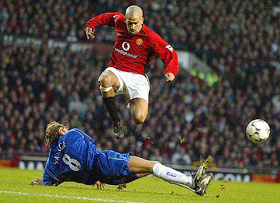
Juan Sebastian Veron


If you've read any of my other football posts, it'll be evident that I have a thing about playmakers. Number 10s. But then what fan of beautiful football doesn't? But there are other kinds of playmakers. Number 10s generally play in the "hole" position between midfield and attack in order to give the opposition the biggest problems. In the hole, neither the opposition's defence or midfield is sure whether they should be marking him. In the modern game, the best playmakers are either man-marked or the responsibility of a holding midfielder. But there is another sort of playmaker, one who plays further back up the pitch, in a more conventional central midfield position, and dictates passing from there. The midfield general, I suppose, though thats a phrase you don't hear so much anymore. Its almost a quarterback role, really, best-suited to players who can deliver high quality long passes to forwards in a split second. Perhaps the most successful example in the modern European game is Andreas Pirlo at AC Milan. Pirlo plays in a position normally associated with defensive midfielders, yet his tackling and covering abilities are limited at best. His passing, on the other hand, his ability to deliver a perfectly weighted through-ball to a sprinting Kaka or Gilardino on the edge of the opponents box from the half-way line, is exceptional. His ability to dictate play through his slide-rule passing is such that one of his nicknames in Italy is "metronomo". But, until last year there was another player in Serie A with a greater range of passing than Pirlo, a more sublime touch, more acute vision. That player was Juan Sebastian Veron.

Like Juan Roman Riquelme, Veron is a controversial figure in Argentine football. Like Riquelme, he was made the scapegoat for the failure of a talented Argentina squad to win a World Cup. But hes a very different player. Elegant and athletic, he covers ground effortlessly. Indeed, football seems almost too easy for Veron, which is perhaps why he has had image problems with fans. He never seems to be trying too hard, trusting instead in his athleticism and his brilliant technique. The fact that he is traditionally paired with a more obviously load-bearing or water-carrying player - Diego Simeone being the supreme example - only makes Veron look lazier and less commited by comparison. But his technique is his greatest strength. While he played for Manchester United, he and David Beckham played out an amazing warm-up routine before every game. They would take up positions on opposite touchlines and stroke the ball across the pitch in long sweeping arcs to one another, neither ever having to move even a step to receive the others pass. It served as a way for each to find his range. Once Veron's range was found, he was capable of punishing any opposition with a series of searching passes between defenders. Observe this volleyed pass, first time, to a breaking Beckham (whose finish isn't bad, either) :


Veron's father, Juan Ramon Veron, was a striker for Argentina and Estudiantes, nicknamed La Bruja, the Witch, which is where Seba's nickname La Brujita (little witch) comes from. He was renowned for his fine technique, another thing his son obviously inherited from him. Veron Jr began his career at his father's old club, Estudiantes, before moving on to Boca Juniors, where he played alongside the likes of Maradona, Claudio Caniggia and Kily Gonzalez. He only played 17 games for Boca in 1996 before he was brought to Europe, another in a long line of young Argentinians poached by big Italian and Spanish clubs. He spent 2 seasons with Sven Goran Eriksson's Sampdoria in Italy, breaking into the Argentina team and playing in the 1998 World Cup, where his deliberate style and ability to dictate the pace and direction of play from a deep position was perfectly suited to coach Daniel Passarella's cautious, defensive style. After the World Cup, Eriksson again bought Veron, this time spending £15million to bring him to Parma. That Parma team - with Lilian Thuram at the back and Hernan Crespo scoring plenty of goals from Veron's assists - won the Italian Cup in 1999. But Eriksson had already left for Lazio, and he soon lured Veron and Crespo to the same club, paying £18.1 million for the former and £35 million for the latter in the obvious hope of buying the Italian title. It worked, with Veron the fulcrum of a Lazio side that was to win the Serie A title, the Italian Cup and the Super-Cup in 2000. Veron was at that time being mentioned as one of the greatest players in the World, and alongside his miraculous passing ability, he was scoring some impressive goals :


But controversy was already following him. There had been talk about the vailidity of his European passport in Italy for some time, and in 2001 a scandal erupted. Veron, feeling that Lazio were not offering him the proper support, moved to Man Utd in July for £28.1 million, a British record fee. His escalating value and the talk of his ability increased expectations at the club, which had won the Premiership in each of the preceding three seasons. Veron slotted into what had been, at its peak, arguably the best midfield in Europe, with Ryan Giggs on the left wing, David Beckham the right, Roy Keane and Paul Scholes in the middle and Nicky Butt as a utility player. Veron was expected to play in the centre with Keane, but the two proved curiously incompatable. Keane was no mere water-carrier in the Simeone mould, but a box-to-box player, who tackled, harried, organised everyone around him and established his own rhythm of simple, short passes and directed and bullied his team all over the pitch. Whereas Keane and Scholes had played together for years and had developed an understanding, Veron and Keane never really got the chance to. Keane's game seemed to cancel out Veron's, making him strangely peripheral in many games, his obvious gifts blunted. Veron also seemed disturbed by the pace and intensity of the Premiership, where he was never given the time he had taken for granted in Italy. After some early promise his performances in England became inconsistent, and his spirit and attitude were questioned. In his first season with United, Arsenal won the League, United exited the Champions League to Bayer Leverkusen, and his status as a great player was brought into doubt.


His salvation seemed to lie in that summers world Cup in Japan and Korea, where Argentina were pre-tournament favourites alongside holders France. This was an Argentina side where Veron was the chief creative force, coach Marcelo Bielsa favouring a European-style pressing game which had seen his squad take the qualifiers in South America by storm. But following the countries recent Economic meltdown, there was a lot of pressure on the players to lift the nation. That job was made more difficult by the group they had been drawn in - this tournaments "Group of Death" alongside England, Sweden and Nigeria. Argentina were to discover that the fast pace that had worked so well in South America was less effective against European teams used to playing at such a pace. They beat Nigeria 1-0 in their first game, but failed to really gel, with Veron quiet and not as dominant as he had been in the qualifiers. He had arrived for the tournament having picked up an injury and struggled for fitness throughout, which was evident in the next game, a 1-0 defeat to England. Though Argentina controlled the majority of the possession, Veron was outplayed by a combination of his United colleagues, Scholes and Butt, with the latter particularly effective at closing down and hassling the Argentine. He was substituted midway through the second half and replaced by Pablo Aimar, a playmaker more in the classic Argentine mould, who, with his quick feet and clever link-up play, offered a much more acute threat in his time on the pitch than Veron had done. Devastated by that defeat to such old rivals, Argentina could only scrape a 1-1 draw with Sweden, and were eliminated from the competition. Many at home blamed Veron.

This was evident when he played in the teams first competitive home match since the World Cup, a South American qualifier against local rivals Chile in Buenos Aires in 2003. The crime of playing so poorly in 2002 was compounded by Veron making his living in England - as banners around the stadium reminded him - and he was booed onto the pitch and throughout the game by his own fans. Soon after, injured yet again, Veron lost his place in the squad. When Jose Pekarman replaced Bielsa as Coach, he made his preference for Riquelme as playmaker plain, and Veron was frozen out. He did not help his case any by feuding with Argentine captain Juan Pablo Sorin, however. The injury that cost him his place in the squad was also to lead to his departure from United. He played better in his second season in England, enjoying a run in the team alongside Phil Neville at the heart of midfield due to injuries to both Keane and Butt. Their twin showing against Arsenal - a gritty 2-0 win when Veron tackled, chased, closed down, and looked as if he had adjusted to the Premiership with ease - was a big turning point in the struggle for the title that season. He had always played better in the Champions League, and this season was no different, as he made and scored goals in the Group stages. However, his injury ruled him out at a crucial late stage in the season when United began a trademark run of victories to come from behind and overtake a flagging Arsenal. This was mostly achieved by the classic Giggs-Keane-Scholes-Beckham midfield, and in th echampions League, Veron returned to fitness too late to help the team overcome Real Madrid at Old Trafford, where they lost on aggregate. He celebrated winning a Premiership medal, but Alex Ferguson had seen that his team played just as well without Veron, and he was sold, against his wishes, to Chelsea for £15 million in the summer.

Chelsea had just been bought by Roman Abramovich and Manager Claudio Rainieri went on something of a spending spree, buying Damian Duff, Joe Cole, Hernan Crespo and Claude Makelele in addition to Veron that summer. Veron started well, scoring a goal in the first day victory over Liverpool, but he missed much of the rest of the season through injury, again returning to be brought on (and played catastrophically out of position, on the wing) in Chelsea's Champions League Semi-final defeat to Monaco. Chelsea fans, suspicious of having signed a player who had seemed to fail so conspicuously in Manchester and preferring Lampard, Cole and Makelele in midfield, already regarded him as a flop, after a single season. Rainieri was sacked and replaced by Jose Mourinho, who loaned Veron to Inter Milan for the next two seasons. Playing again at a pace he liked and in a more sympathetic, latin environment, Veron began to show his qualities once more, helping Inter to Italian Cup victories in 2005 and 2006.

This is a story with something of a happy ending. In 2006, Veron returned to Argentina, to the club of his boyhood and his father, Estudiantes. Now coached by his old friend and midfield minder Diego Simeone, Estudiantes had not won an Argentine championship in 23 years. With a month left in the Argentine Apertura, it looked like they would have to wait. But Boca Juniors kept on dropping points and Estudiantes, with Veron's experience and vision well-served by a young team full of hunger and potential, kept on picking them up. Eventually it came down to a play-off. Boca went 1-0 ahead in the first half, but Estudiantes, encapsulating their season in a single match, emerged victors at 2-1, and won their first championship in 23 years. A few weeks later, Veron was called up to the Argentina squad for the first time in 4 years. New Coach Alfio Basile was ardent in his desire to be an actual working coach for Argentina and not just a selector, and so he called up a squad of domestic-based Argentine players for a training camp. Veron obviously benefitted from this and with Basile declaring his intention to select more of these players in the future, there is a chance that he may play in this summers Copa America in Venezuala. Perhaps his comeback - and redemption, in the eyes of Argentina fans - is still to play itself out. In terms of his career, his major error was in underestimating just how difficult it would be for him in England - he trusted in his talent, and then discovered that it was a talent requiring specific conditions in which to flourish. Those years of failure at what should have been his peak hang over his career, but he is a player with Champions Medals from Italy, England and Argentina on his mantel, not a bad haul by any standards.

Heres a good compilation of what hes capable of, with as many great asists as goals :

Monday, February 5, 2007

Juan Roman Riquelme


I've written before (in the very first football entry on this blog) about the importance of the Number 10 shirt in Argentinian football and about Argentina's stupendous line of creative playmakers since Maradona. But Maradona is an impossible player to emulate. Arguably the greatest player in history, easily the greatest player of his generation, he could do everything that a creative player is required to. He could dribble like no player before or since, twisting and teasing, his low centre of gravity and amazing acceleration making him difficult to dispossess even illegally. He could run a game with one or two touch passing, sweeping the ball this way and that across the field, dragging defences out of shape with flicks and perfectly weighted long balls. He could shoot from distance, either delicately placing or blasting the ball wherever he wanted it. He obviously wasn't the greatest player in the air - altough he could still outjump Peter Shilton, a good six inches taller than him when it mattered - but he was usually the player supplying the crosses, not the player on the end of them. His true genius was in the combination of all these talents. On his game he was unplayable, no team could cope with him. In the 1986 World Cup Final, Germany detailed two players to mark him, hoping to copy the effect Berti Vogts had on Johann Crujiff in the 1974 Final. Lothar Matthaius, West Germany's best player, followed Maradona everywhere, and when the Argentine had possession Matthaius was joined by one of a revolving number of players in closing him down. For most of the game this worked, but Maradona only needed an instant to hurt an opponent. His pass had set off Valdano on the run that led to Argentina's second goal, and not long after, he embarked on one long run right through the centre of the German defence, evading tackles, which ended with him in mid-air having been kicked by two players at once. Then, with seven minutes remaining and the game tied at 2-2, Maradona, with three Germans in close attendance, found Burruchaga breaking free in the German half with a beautiful first-time volleyed pass. 3-2. Argentina were World Champions.

Most of the Argentinians who have been hailed as "the New Maradona" have excelled while running with the ball. It is this aspect of football, the "gambeta", as they call it, which most excites the Argentine football imagination. It is also what Maradona is best associated with, his goals against England and Belgium in the Quarters and Semis of the 1986 World Cup springing instantly to mind. Players like Saviola, D'Alessandro, Messi, Ortega, Tevez and Aimar have all been excellent dribblers, while Juan Sebastian Veron and Juan Roman Riquelme are more old-fashioned, passing playmakers. Riquelme in particular seems the last of a dying breed. He has no pace to speak of, and so would seem unsuited for the hustle and flying shrapnel of a modern midfield. Yet he never seems hurried and always seems to have time and space on the ball. He never panics. When he is man-marked, he finds enough space to hit devastating one touch passes, Maradona-style. His technique is beautiful, his control flawless, allowing him to caress the ball and make it do exactly what he wants, and so those passes, be they long or short, volleyed or slid along the grass, never seem to miss their intended targets.

Much of Riquelme's work goes almost unnoticed. He takes the ball and relays it accurately, often with the same touch. He moves with his head up and reads the game superbly. He is always moving into space, calling for the ball, moving it along and finding space yet again. This is not often flashy work, as the ball moves back and forth across midfield and his team probes for weakness. But it is Riquelme dictating the pace of that probing, Riquelme's eyes the keenest at identifying the weakness. Creating angles, pulling opposition players out of position, making space for his teammates. The game of the classic playmaker is all about angles around the penalty area, creating gaps in a defence through which to slip the ball. Riquelme is a master at this art. The second goal of Argentina's 6-0 routing of Serbia in the 2006 World Cup was the goal of the tournament, with 24 passes in a minute in the build-up, and its a typical example of Riquelme's subtle prompting. He plays a one-two with Saviola before the ball is passed across the face of the Serbian area to Cambiasso. His touch is a mere flick straight into Saviola's path with the outside of his right foot that instantly eliminates two Serbians from the play allowing the move to culminate in a beautiful goal :


That sort of touch is pure Riquelme : casual, perfect, with an almost sensual feel for the properties of a football. He is capable of dribbles and tricks as well, his ability to get himself out of tricky situations enabling him to maintain his teams possession of the ball, obviously an eternal priority :


His touch is so subtle and delicate that if you watch many clips of him in possession he barely touches the ball with his toes or with either instep or outstep, as most players do. His lack of pace is almost an advantage when it comes to controlling the ball - when faced with an approaching defender he knows he cannot knock the ball beyond them and then outsprint them to collect it. So he has to be clever and use trickery. He tends to drag and spin the ball beneath his studs, minutely inclining and angling his ankles to spin it in first one direction and then another. He is also extremely strong - he is 6ft - and can turn his back on a defender and hold the ball up seemingly indefinitely, losing little ground with twists and turns until he sees a runner he can pass to.

You would imagine that such a talent would be cherished by any footballing nation, but Riquelme is a controversial figure in Argentina. The Argentine style has always combined skillful individual dribbling with fast, short passing along the ground. The above goal against Serbia is perhaps the perfect example. Riquelme's critics contend that he slows the game down too much when in possession. He has been derogatorily called "the tollbooth" in reference to the appearance that everything stops when it comes to him. But this is to miss the point. Riquelme is always in control of that pace, skillful enough to slow things down when he needs to, but with the timing and technique to inject just the right amount of pace into the movement of the ball at the right moment. Jose Pekerman, coach of Argentina at the last World Cup and a big fan of Riquelme, has commented that in football, it is the ball that needs to move fast, not the player. He was the first National coach to give Riquelme a regular place in his starting line-up. Indeed, he built his team around the playmaker's talents, meaning that the likes of Veron and Ortega, still major figures in Domestic football, were dropped, and Aimar, Saviola, Tevez and Messi all rotated from the bench to supplementary positions in the teams offensive formation. He was rewarded by Riquelme by an utterly dominant performance against Brazil in a South American qualifier in Buenos Aires, topped off by this goal and the audacious volleyed pass with the sole of his boot that precedes it:


Argentina qualified for the World Cup ahead of Brazil. After a strong win against a powerful Ivory coast and the destruction of Serbia, they were favourites in the early stages. Riquelme was controlling games in the manner expected of him, but he seemed to tire as the tournament progressed and was not quite so influential in the first knock-out match against Mexico, though Argentina edged it with Maxi Rodriguez's wonderful goal. Against Germany, in a tight midfield battle, Riquelme was again crucial. Argentina were leading and dominant, Riquelme spraying passes around and the Germans unable to hold onto the ball when they could get it off the opposition. But Pekerman surrendered to his defensive instincts and substituted his Number 10. Moments later the Germans equalised and they, not an Argentina without its conductor, were the dominant team throughout extra-time, only to win on penalties. Pekerman resigned, Riquelme only lasting a single game as Captain before retiring from International football altogether, claiming that the criticism he had attracted in Argentina during the World Cup had made his mother sick.

He has had a tough time with the Argentine press ever since he left the country to move to Barcelona. He had been signed by Boca Juniors from Argentinos Juniors at the age of 17, and broke into the first team a year later. Here he became a central figure, Maradona's favourite player, and bearer of the heavy burden that is the Number 10 shirt. He wore it lightly at that time, helping Boca win the Argentine Championship three times between 1998 and 2001, winning the South American equivalent of the Champions League, the Copa Libertadores, in 2000, and the Intercontinental Cup (beating Real Madrid 2-1)in the same year. He was voted South American Footballer of the Year in 2001, putting him in the company of legends like Maradona, Zico, Pele, Socrates, Enzo Francescoli, Carlos Valderama and Romario. In 2002 he became involved in a contract dispute with Boca and was eventually transferred to Barcelona. He already had a reputation as a quiet player, singular in his needs in training, and unable to perform to the best of his abilities unless he had a midfield "minder" to do his dirty work. At Barcelona, coach Louis van Gaal made it clear to his new player that he did not actually want him, that he was a "political" signing, and promptly deployed him on the wing, utterly wasting his talents. To compound these problems, his brother was kidnapped and held for ransom in Buenos Aires only a few weeks after he left Argentina. Riquelme negotiated with the kidnappers and eventually paid the ransom money. But unsurprisingly he played fitfully after his first few months in Spain, until Barca eventually sent him on loan to Villareal in 2003.

Villareal are a small club in a small town, and their Chilean coach, Manuel Pelligrini, based his playing style on South American football, recruiting a backbone of talent from that continent. Brazil-born midfielder Marcus Senna won the ball and did the running for Riquelme, while Uruguayan Diego Forlan gave him a yellow shirt to aim for with his through-balls. At the back, Argentine captain Juan Pablo Sorin commanded the left wing, and there were three other Argentines, an Ecuadorean, a Bolivian and a Mexican in the squad that reached the Semi-finals of the Champions League in 2006. That Champions League run was due to the disciplined, fast-passing game Villareal played, and Riquelme was utterly cruical to that. Diego Forlan won the European Golden Boot in 2005 with 25 League goals, a good proportion of them coming from Riquelme assists. He was the same player he had been at Boca, and the name on his shirt read "Roman" instead of Riquelme to signal the psychological break from the events at Barcelona. He was nominated for the FIFA World Player of the Year award the same year and came second only to Ronaldinho in year-end polls amongst Spanish football writers. But it all went wrong for him in 2006. That World Cup exit and his subsequent International retirement, at the age of 29. His penalty miss against Arsenal in the Semi-final of the Champions League, which resurrected old Argentinian criticisms of his lack of mental toughness. And in recent months he has fallen out with Pelligrini and been left out of the Villareal squad which is not performing to anything like its levels of 12 months ago in his absence. The club signed Chilean wonderkid (and Winner of this years South American Player of the Year Award) Mattias Fernandez from Colo Colo around the same time Riquelme and Pelligrini's problem came to light. Fernandez is a more modern style of playmaker, and he has gone straight into the team, playing in Riquelme's position, but without much success so far. It takes a while for a South American to acclimatise to European football, as Riquelme would testify.

So Riquelme spent much of the transfer window looking for a move away from the club he drove to unprecedented success. Bayern Munich, Man Utd and Inter Milan were all rumoured to be interested, but nothing came off and at the time of writing he remains a Villareal player, though one who is not playing. For me, he is one of the top 5 players in World Football, and the fact that he is essentially without a club at the moment is one of those instances of insanity football throws up from time to time. This compilation ends with a few minutes worth of his performance against England in last years friendly in Geneva. I remember reading after that game the English players testimonies about how elusive and superb he had been. Watching the match, the first half had seemed almost a private duel between Riquelme and Wayne Rooney, each daring the other onto the next piece of intuitive genius, until Riquelme pulled away from Rooney, the younger man's relative inexperience showing as Riquelme dictated the course of the game and repeatedly made John Terry look like an idiot. Pekerman substitued him with only a few minutes left and Argentina 2-1 ahead. In his absence, and granted some possession of the ball, England scored two late goals and won the game. Of Course Pekerman repeated the mistake in the World Cup....


*But hes still playing, I hear you cry. Well, just about. But I never said those were the rules, did I?
  • Goal.com
  • 101 Great Goals
  • Football 365
  • Guardian Football
  • Hasta el Gol Siempre
  • BBC Football
  • Football Shirts
  •