A group of clips of Number 10s. Playmakers. Inside-Forwards. Whatever.
Zico destroys Liverpool, 1981:
Berlusconi's favourite player, the greatest Montenegran player of all time, and one of the best in the world on his day, Dejan Savicevic, Il Genio:
Enzo Francescoli, who will be the subject of a long piece here some day:
Gunter Netzer, the great German playmaker, and Der Bomber. Plus a lovely German song:
Enzo Scifo, little Italian-born Belgian with great feet and a beautiful range of passing:
The greatest hairstyle ever seen on a football pitch, and one of the greatest passers of the ball, too. Watch for a couple of sublime assists from Colombia's 5-0 defeat of Argentina in Buenos Aires in 1993, where "El Pibe" utterly dominated the game:
Showing posts with label playmakers. Show all posts
Showing posts with label playmakers. Show all posts
Thursday, June 26, 2008

Wednesday, June 11, 2008
Claudio Borghi

It must be like being the cleverest pupil at your school. You always do the best, gets the highest marks in tests, receive unending praise from a teacher. Then you have to leave, and go to another school, a school for older children. Maybe you're not the cleverest pupil anymore. Maybe somebody else - another who was the best in their class - maybe they are cleverer, maybe they do better in tests, maybe they get more praise. Maybe, for the first time, they make you feel inferior.
Or maybe not. Maybe you're the one making the others feel inferior, all the way through school, through every grade and age. But then you reach University. And you don't stand out at all. Here, everyone was the cleverest at their school. This is a thousand people who have always made others feel inferior.
Now imagine you're a young footballer. You play as the link between the forwards and the midfield, in the hole. Your passing is beautiful - visionary, incisive, perfectly timed. You can dribble too, able to swerve and turn at speed past dumbfounded defenders. You score your fair share of goals. You have been something of a phenomenon at your club - a golden boy, of whom great things are expected. You are called up to the National Team, hoping to play a major role in the World Cup. Only there is another player, who plays in your position, who has also been called up. He is, there can be no denying it, better than you are. He is the best player in the World, maybe the best player of all time. He leads your country to victory at that World Cup, scoring some unforgettable goals, and you are lost in his wake. You never play for your country again. Your career -while continuing in a variety of countries for a multitude of clubs - flounders, to an extent. You never live up to those early expectations. You are Claudio Borghi. You are a Nearly Man.
Borghi's great misfortune was to emerge as a young playmaker in the mid-1980s when Maradona was at the peak of his abilities. If he had been Chilean or Paraguayan or Mexican, he would have probably become a legend. As it was, he starred in the Intercontinental Cup Final in Tokyo in 1985, when Juventus beat his club, Argentinos Juniors, on penalties. Italy was so impressed by his extraordinary promise that AC Milan signed him in 1987, but the "3 foreigners" rule meant that he was loaned out to Como (the foreigners preferred by coach Arrigo Sacchi were Van Basten, Gullet and Rijkaard) and upon his return he fell out with Sacchi and was sold on, ricocheting via Switzerland's Neuchatal Xamax to River Plate, Flamengo, Independiente and a clutch of clubs in Chile. That club career would undoubtedly have panned out differently had Borghi been playing for Argentina at the crux of an attack spearheaded by Valdano. The confidence and increased status in world football that would have given him would probably have extended his stay in Europe. Instead Maradona was the chosen one, and the timing could not have been better for his career. Borghi, in contrast, is known now primarily as a Coach, having enjoyed a remarkably successful tenure with Colo Colo, Chile's biggest and most historically prestigious club.
Its not something you read about all that much. The reserves, the substitutes, and how they feel about their role, holding up the squad at the heaviest point. What it must feel like to be a gifted player, only not gifted enough. Sport loves a hero, so those who carry out an important but unseen task are of no interest, and the media obsession with every aspect of football has seemingly worsened this state of affairs. To be an understudy. The strange pressure of it, the resentment, the effect it must have on one's self-worth...
It is more obviously pronounced in a National team, where a player who is the first choice at his club can become second or even third in line. A truly great player can overshadow a dozen others with his talent, his intimidating influence. Zinedine Zidane was always going to be the conductor of the French national team from his first emergence as a young player. But his talent was so vast and so much more complete than that of his rivals that they were all but cast into the wilderness. If Zizou was fit, he played. Hence Johan Micoud, a fine attacking midfielder in his own right, played rarely for France, if at all, when in another generation, he might have been the creative lynchpin. Vikash Dhorasoo, another mercurial playmaker suffered a similar fate (his documentary, "Substitute", basically chronicles his frustrating experiences as Zidane's understudy during the 2006 World Cup). Robert Pires would possibly have developed as a traditional playmaker in the hole if not for Zidane's pre-eminence in the position. Instead he played on the wing, in tandem with Zidane, his talent too great and versatile to be ignored.
National teams are rife with great players being second-best to even greater players, or just to players who fit into the coaches tactical approach better. In modern International football, Riquelme keeps out the genius of Aimar for Argentina. Quaresma and Simao constantly leap-frog one another for Portugal. The Brazilian squad is so bursting with talent that there will always be immense players left on the bench or not even in the selection at all. How does any manager contain Ronaldinho, Kaka, Elano and Diego when there is only really room for a single attacking midfielder on the pitch? He tries to pick as many of them as he can and his team is an unbalanced mess, albeit an unbalanced mess stuffed with genius. So Ronaldinho and Kaka - as the biggest stars, the most proven talents - have been the two most favoured in the past. But this demeans a talent as great as Diego's. He is too good to be a nearly man. They all are.
In the 1980s, the heroic athleticism of Bryan Robson was generally preferred to the classier, silken skills of Glenn Hoddle by a series of England managers. Hoddle was the sort of player teams should be built around. Instead he never lived up to his undoubted talent for his country. This fate has befallen a series of the more obviously talented players to emerge in English football over the past three decades, from John Barnes to Matt LeTissier. Though neither of those players was regularly excluded because of any other single rival, they still lost out to the likes of Steve Hodge and Steve McMahon. It happens in other European countries too.

In the 1960s Italy possessed two extraordinary playmakers - Sandro Mazzola and Gianni Rivera. Mazzola was the star of the all-conquering Inter Milan team of the 60s, while Rivera played for AC Milan (the picture above shows Rivera tackling Mazzola). They were similarly gifted players, both capable of pinpoint passing, either able to dribble or shoot from distance. Rivera was perhaps the more silken of the two, Mazzola a burlier, more athletic presence. Each was the talisman for his club, winning numerous Scudettos and a couple of European Cups each. However, Italian National coach Ferruccio Valcareggi believed that they could not play together. He favoured Mazzola (despite Rivera's greater popularity) and started him in the first matches at the 1970 World Cup. Without Rivera, who had been so effective when Italy had won the 1968 European Championship, the Italian offence couldn't get started. So Valcareggi developed a scheme he called "stafetta" (which translates literally as "relay"). He would play Mazzola for the first half and Rivera for the second. Italy progressed to the final, with Rivera in particular shining as he scored the winner in the 4-3 semi-final victory over West Germany. For the final however, Valcareggi reverted to type and played Mazzola alone until eight minutes from time, when he brought on Rivera. Italy lost 4-1. You could never really refer to either man as a "Nearly Man". But they strangled one another's International careers. Both must have wondered what it would have been like if not for the other.
Rivera in action:
In the late 1980s, Guiseppe Giannini was the playmaker for the Italian team and captain of Roma. But the emergence of Roberto Baggio meant that he lost his place in the starting line up for the national team at the 1990 World Cup, and he retired from Internationals in 1991. He could see what was coming, and he was too proud to be another nearly man, no matter how much genius Baggio possessed. Some players seem almost offended by the competition for the role their career has taught them to consider theirs alone, as if its unseemly. Others are inspired by it. And some, like Claudio Borghi, find themselves facing a force they cannot defeat, a skill they cannot match, and they slip quietly away.
What, then, of Claudio Borghi? Well here he is, wearing the Number 10 shirt and scoring a quite sublime goal from late in his career, somewhere in Chile I think, in the only clip I could find:
Wednesday, November 28, 2007
Football in sun and shadow
Sometimes I just want to put some beautiful clips of football up, without having to write a long post about some Uruguayan or Bulgarian player from the 80s to accompany them. They speak for themselves, anyway, unless I say they don't, in which case I'll add a witless comment.
Anyway, the beautiful game:
Almost the best part of this is that he misses:
He doesn't miss:
Matias Fernandez:
Dejan Savicevic, a little genius:
Hugo Sanchez, making that Ronaldinho effort look easy:
Diego Maradona, playing for Spurs. No, seriously:
Anyway, the beautiful game:
Almost the best part of this is that he misses:
He doesn't miss:
Matias Fernandez:
Dejan Savicevic, a little genius:
Hugo Sanchez, making that Ronaldinho effort look easy:
Diego Maradona, playing for Spurs. No, seriously:
Sunday, July 15, 2007
Argentina 2007

During the 2006 World Cup, at the place where I work, some of us were allowed to take days off to watch certain games. So the real football fans got to watch England's games from home, or the pub. Which is as it should be. Obviously, Ireland didn't qualify, so instead, I took a day off to watch Argentina - Serbia. Argentina's other group games were at night and I could watch them after work, but the Serbia game was in the afternoon. So I got up late, watched the preceding game, then settled down to watch Argentina destroy (an admittedly weakened) Serbia. It was the most exhilarating game of that World Cup for a fan of beautiful football. Argentina pressed the Serbians high up the pitch, were characteristically sharp and miserly in defence, and played the ball around in a series of short, beautiful passing moves. Riquelme - probably my favourite player in World football for the old-fashioned grace and sublime loveliness of his style - ran the game, supplemented by the constant movement of the likes of Saviola, Crespo and Rodriguez around him. Mascherano and Cambiasso patrolled midfield, snapping at the Serbians, retaining the ball impressively, shielding the Argentine backline. They scored the goal of the tournament, and one of the best goals ever scored at a World CUp. In the second-half, with the game won, Argentina brought on two young players, both of whom scored: Carlos Tevez and Lionel Messi. They won 6-0. I watched the whole match in that state you sometimes reach when you realise a film is truly great or when you really love a record: it made me happy, and the awareness of this happiness meant that I felt lucky to be experiencing it. So much modern football is defensive and pragmatic, the pressure of money and demands for success mercilessly squeezing all the artistry and creativity from a game which thrives upon those qualities that it was almost a relief to witness a team devoted to playing football - and excuse this cliche - the way it should be played.
Well, Argentina may have been the best team at that World Cup, but they didn't win it. Their coach suffered a failure of nerve, and they went out on penalties to a typically fit and well organised but inferior German side in the Quarter-finals. But the promise of that team, and the fact that so many of its key members were so young, meant that their time would surely come again. They will probably be among the favourites for the 2010 World Cup in South Africa. But, as I write this, they are slated to play their arch-rivals Brazil in the final of the 2007 Copa America in Venezuala in approximately 25 hours. Argentina owe Brazil for a few recent results: in the final of the last Copa America, in Peru in 2005, twice Argentina led, only for an Adriano goal in the last minute of injury time to rescue Brazil, who went on to win the game on penalties. In the final of the 2005 Confederations Cup, Brazil delivered a 4-1 tonking, and there was a similar result in last years friendly at the Emirates Stadium in London where Brazil ran out 3-0 winners.
Brazil are feted throughout the World for the quality of their football, and based upon the calibre of the players the country has produced in the last decade, that seems reasonable enough. Probably the players currently reckoned to be the two best in the World are Brazilian, after all: Kaka and Ronaldinho. Add to those names this lot: Robinho, Daniel Alves, Ronaldo, Juninho, Adriano, Ze Roberto, Cicinho, Fred and Diego. But in practice, Brazil rarely play the "Joga Bonito" dreamt up by Nike's marketing department in competitive games. Instead they favour a far more pragmatic, hard-nosed approach with strong holding players protecting their defence, relying on their flair players to produce some magic from nowhere to win them matches. Those players - Robinho, Anderson and Diego so far in this Copa America tourament - can become isolated, without a supporting midfield player linking play for them, and this puts them under intolerable pressure, as the failure of Ronaldo, Ronaldinho and Adriano to sparkle at the last World Cup demonstrated. That the Brazilian coach, Dunga, was a holding midfield player himself, and won a World Cup in a team more respected than loved in Brazil probably hasn't helped him with the reception his team has received at home during this tournament. They have underwhelmed, scraping through most of their games - a 6 goal thumping of a Chilean side reeling from scandal aside - and were fortunate to beat an aggressive, well-organised Uruguay in the semi-final. What makes Brazil look worse is the form of their biggest South American rivals. Because at the moment Argentina look like the best side in international football, and they are playing with the sort of flair traditionally expected of the Brazilians.

They may lose in Sunday's final - Brazil have a way of getting results when it counts, Argentina a way of choking at the very worst moments, and if the Albiceleste have a weakness it may be a lack of pace in defence, just the sort of thing Robinho will be looking to exploit - but what will be remembered will be some of the football they have played. Coach Coco Basile has stayed true to the Argentinian values of football, favouring a fluid attacking line-up playing with a traditional number 10 in the form of Riquelme, who has probably been the player of the tournament. Observe this perfect pass to Lionel Messi against Peru, taking 3 defenders out of the game with a single stroke of the boot:
Riquelme has also scored 5 goals, including this finish with his weaker left foot:
And this free-kick, which he passes around the wall and inside the far post, Zico-style:
But aside from his goals and assists, Riquelme is a force for positive football when hes on the pitch. He always keeps the ball moving, he rarely - if ever - surrenders possession, he always looks for space, and he encourages his teammates to do the same. The fact that his teammates need very little encouragement is testament to their class and skill. Also to the fact that each of Argentina's front three - Riquelme, Messi and Tevez - can play as a Number 10. Their interplay has been breathtaking, each displaying vision and individual skill when required. None more than Lionel Messi, finally being given his chance in the National team after being restricted to the bench for most of the World Cup. His dribbling ability, acceleration and touch are all superb, but he has the boundless courage and confidence of youth, never ever afraid to take on an entire massed defence with the ball at his feet. He has also scored what was probably the goal of the tournament:
In the first two games of the tournament, Basile went with a traditional "Little & Large" front two of Messi and Hernan Crespo, leaving Carlos Tevez on the bench. Crespo is a centre forward of the highest class, a predator whose movement, aerial ability and eye for goal are comparable with anybody playing in his position in football today. He showed his value to his country with his goals in each of his first two games. His injury - taking a penalty kick - in the second match eventually allowed for the introduction of Tevez, and the Argentine frontline was suddenly an entirely different beast. Tevez shares Messi's dribbling skill, but is more powerful, better at holding the ball up, more direct, and more useful at pressuring defenders when he is hunting possession. The combination of Messi and Tevez running onto passes from Riquelme is a terrifying one for a defender and leads to goals like this one:
A couple of other players have been recalled to the squad and allowed the attacking line to work its magic. Juan Sebastian Veron has played in deep midfield alongside the more defensive-minded Esteban Cambiasso, and his presence is one of the key factors in Riquelme's freedom of expression. Veron takes the ball off the defense and from Javier Mascherano and drills precise long passes across the pitch or feeds Riquelme, allowing the playmaker to remain in the part of the pitch where he can do the most damage. Veron is also capable of shooting powerfully from distance, as this effort against the USA demonstrates:
However, hes never been the most solid midfielder from a defensive point of view. The return of Javier Zanetti at right-back has meant that he has never yet had to be. Zanetti works the entire right side of the pitch, racing forward to support attacks and yet somehow always positionally sound in the defensive third, allowing Veron to play his way without ever becoming a liability. Also vital in allowing the creative midfielders to work their magic has been Javier Mascherano in the holding role, the key No. 5. With the decline in Claude Makelele's game, Mascherano has rapidly developed into probably the best player in this position in the world, as his superb marshalling of Kaka during the Champions League final suggested. His anticipation and reading of the game are startlingly astute, meaning that he always seems to be in the right area of the pitch to snuff out an attack as it begins. Combine this with great stamina, thunderous tackling and the ability to keep his passes simple yet intelligent, and you have the perfect holding midfielder. Hes also begun to score goals, notching up two so far in this tournament, the first of them a beautiful finish:
Argentina's strength in depth means that there are quality alternatives to all of these players on the bench. Pablo Aimar is a great playmaker, more similar to Messi than Riquelme in his movement and touch, but with enough quality to have guided Valencia to a Spanish title a few years ago. He would be the Star player in almost any other International team, yet is reduced to guest-starring for Argentina. A role he can play to perfection :
Fernando Gago offers a more creative alternative to Mascherano, Milito and Palacio are quality strikers in the target man and pacy runner mode respectively and Lucho Gonzalez can play in more or less any position in midfield with equal effectiveness. If the team has a weakness, it is in defense. Argentina have yet to be properly tested defensively in this tournament, and Brazil would be expected to offer that test tomorrow night. Gabriel Heinze is committed and strong in the tackle, but vulnerable against pace, as is the ageing, if still commanding, Roberto Ayala. Gabriel Milito has had a poor tournament, seemingly prone to slips in concentration, something he will need to address before he finds himself facing Robinho & co.
Despite this, Argentina should really beat whatever side Brazil put out tomorrow to win the tournament. What all of the clips and words above don't really transmit is the impression of Argentina's play. The way the team moves the ball around, husbanding it jealously across the pitch in little triangles, the corners of which continually circle and wheel around one another. The absolute perfection of touch and technique. The little dribbles and back-heels and stepovers, performed with casual fluency by all of the players. The way passes are perfectly weighted, rolling with immaculate timing into the stride of a player in motion. The killer instinct in front of goal. The hunger for the ball, the constant support for the player in possession. The way they contemptuously shrug off teams who attempt to foul and bully them out of their rhythm. The tireless pressing of the other team when they have the ball. The way the scorers frequently race screaming to the bench so that the entire squad can celebrate together.
Its all been beautiful and exhilarating to watch. The only other team I've written about in such glowing terms are Brazil in 1982, and while it may be premature to rate this team alongside that one, they play with a comparable love for the beauty of the game, with a joy and a freedom missing in too much modern football. That team is remembered fondly despite never having won anything significant, and whatever the result in the final, I have a feeling this Argentina side will be similarly regarded by posterity. Joga Bonito, indeed.

Monday, May 14, 2007
Rui Costa
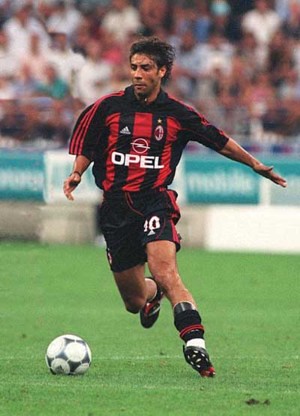
Rui Costa was perhaps the most old-fashioned, elegant playmaker of his era. But he played in Italy at a time when Serie A had more than its fair share of the world's great playmakers - Zinedine Zidane, Dejan Savicevic, Allessandro Del Piero and Roberto Baggio, among many others, all played against Rui Costa during his time at Fiorentina and AC Milan - and as a result he never quite received the recogniton he deserved. In addition, he was part of Portugal's famous "Golden Generation", alongside the equally talented Luis Figo, meaning that he never even received the acclaim he warranted in his homeland, always having to share the spotlight with his team-mate. But in the late 1990s, if you searched Europe for a player capable of controlling the pace of a game, or of opening up a defence with a dribble or a perfectly placed through-ball, there was really nobody better.
His vision was perhaps his greatest, most unique gift. There is a sequence in the video below highlighting his ability to pick out a forward closing in on goal, often from within the centre circle, with a single, perfectly weighted, precisely-threaded ball between scrambling, panicked defenders. Forwards as celebrated as Gabrielle Batistuta and Andrei Shevchenko both benefitted greatly from this talent. Rui Costa made it look effortless, never seeming rushed in possession and always appearing assured of what he intended to do, he seemed always to have more time than anyone else on the pitch:
That confidence obviously came from his technical virtuousity. His touch was gentle, but he was blessed with the pace and acceleration of a winger when he strode forward with the ball, shedding defenders as he went with shimmys and stepovers. He had the ability to pick out a pass at any moment, but he was just as likely to perform a lollipop or set himself for a shot. So many of the goals in the above video are placed finishes, curlers which he caresses into the corner of the net, mockingly just beyond the grasp of a goalkeeper, his composure marked and admirable. But he was also capable of drilling shots from outside the box:
This stupendous goal for Milan shows a combination of his skills, with a little run to start off, then a blasted curling ball into the top corner from outside the box :
Born Rui Manuel Cesar Costa in Lisbon in 1972, he was spotted at a trial for Benfica, the Lisbon club he supported throughout his childhood, by none other than Eusebio at the age of 10, and spent his teens playing for Benfica's youth teams. In 1990 he was loaned out to AD Fafe for a season, gaining experience of the professional game. Perhaps the greatest experience he gained, however, came from his time spent in the Portugeuse Youth system. Overseen by Carlos Quieroz, that system had produced the team that won the Under-20 world Youth Championship in 1989 in Saudi Arabia. In 1991 the Championships were held in Portugal itself, and a team including Costa, Figo, Fernando Couto, Joao Pinto, Paolo Sousa and Sergio Conceicao beat Brazil in a penalty shootout in the final. Rui Costa took the deciding penalty, watched on television by most of the population of Portugal, and expectations of what this "Golden Generation" would achieve at senior level were stratospheric. Costa was welcomed into the first team at Benfica during the next season by coach Sven Goran Eriksson, playing in his customary role as attacking midfielder. I first saw him play when Benfica beat Arsenal at Highbury in the European Cup in 1994, and he was the oustanding individual. He liked to pick the ball up in central midfield and stride forward with his distinctive busy movement, skinning opponents and evading tackles before laying the ball off. Some players wind up before they strike the ball, you can see them prepare their body in the seconds before they execute the move they intend, their shoulders tigtening slightly, their hips rotating, heads maybe tilting to a certain angle. But Rui Costa struck the ball with fantastic ease - it rolled off his feet, always in his stride, as if he had not even meant to pass it, as if the perfectly placed ball he had just delivered was an accident, a fluke of his pumping sprint. That sprint too - he was deceptively pacy - never looked too strenuous, due to his strange jerky gait. He worked hard, covering lots of ground, working the spaces of midfield, but never tracking back, not making too many tackles, as if he thought defensive duties were beneath one with such extravagant technical gifts. One of his managers at Fiorentina, Claudio Raineiri, was prompted to ask him if all games in Portugal were played on a slope, because he never ran back to defend.
He won a Portugeuse league title and cup at Benfica before he was sold to Fiorentina in 1994. Instantly striking up an understanding with the awesome Batistuta, he remained there for 7 seasons, winning two Italian Cups and constantly being linked with transfers to bigger clubs. But he enjoyed the pace of life in Florence and obviously enjoyed the adoration of the Fiorentina fans, where he and "Batigol" were two very big fish in a relatively small pond. He also enjoyed absolute freedom on the pitch, especially under Turkish coach Fatih Terim in his last season. Terim, realising how important Costa was to the teams attacking style, especially in the absence of Batstuta, who had moved to Roma, told the Portugeuse that he had the freedom of the pitch, he could go anywhere and do anything he chose. When Terim moved to AC Milan in 2001, he brought Costa with him for a fee of 35 Million euros. Here he was instrumental in Milan's European success, helping them to a Champions League victory in 2003. That summer, Milan purchased the young Brazilian Kaka, and he quickly replaced the ageing Rui Costa as the player in the withdrawn role behind Milan's strikers. They are very similar players, and it is a great tribute to Kaka that his contribution was so great that Milan have not missed Costa since he left to return to Benfica in 2006. In those last two seasons at Milan, Costa played rarely, since Milan had a surfeit of playmakers - as well as Costa and Kaka there were Clarence Seedorf and Andrea Pirlo. He is still contracted to Benfica and intends to end his career there, where it started.
The Golden Generation never really lived up to its billing, though they came close. In Euro 96, they were eliminated by eventual finalist the Czech Republic in the quarter-finals, having played some lovely football to get there. However, they never really looked like the finished article, the many individual talents on display not quite blended properly yet. They had been in Ireland's group for the Qualifiers, and I remember being shocked by how fluent and skillful they had seemed when they took us apart, 3-0, in Lisbon. Costa scored a beautiful goal that night, firing a 30 yard screamer into the top corner, and he utterly controlled the game, embarassing our midfield. They seemed to be living up to their billing as "the European Brazil", at least in terms of the flair and skill with which they playe dthe game. They were grouped with European Champions Germany in the qualifiers for the 1998 World Cup, a tournament for which that group would perhaps have been at its peak. During the German tie between the two countries, with Portugal leading, Rui Costa was sent off for taking too long to leave the field, Germany recovered to win the match against 10 men, and they qualified for the tournament at Portugal's expense. Euro 2000 was to be the first tournament at which they showed the true beauty and effectiveness of their football, with Costa orchestrating everything. Their amazing 3-2 win against England in their first game, when they came back from 2-0 down, set the tone. Alongside hosts Holland they were the entertainers of the tournament, playing flowing, attractive attacking football. However they ran into World Champions France in the semi-finals and were eliminated, after a tense, tight contest, by a controversial Golden Goal. Zidane scored with a penalty after Abel Xavier handled in the area, the Portugeuse threw a massive tantrum, but they were out. Worse was to come in the 2002 World Cup in Japan & Korea, where Portugal, in common with other favourites France and Argentina, were dumped out of the tournament in the group phase . After an hour of their first game against the USA, Portugal were 3-0 down, a barely imaginable scoreline. They pulled two goals back, but their campaign never really recovered from that early shock, even though they beat Poland 4-0. They needed a draw against South Korea in the last game to advance to the knock-out phase, but instead had two players sent off and lost to a late goal from Park Ji-Sung.
The Golden Generation had aged, and both Costa and Figo were no longer considered certain starters for Euro 2004, which Portugal hosted. A new generation of stylish Portuguese players led by Cristiano Ronaldo and Simao Sabrosa had emerged, and Brazilian coach Phil Scolari trusted them, loading his squad with players from the Porto team which had just won the Champions League. But Costa still made a worthy contribution, displaying his class when he came off the bench during the quarter-Final clash with England to score this goal:
The final, which Portugal lost to Greece, would prove to be his last match for his country. He is the third most capped Portugeuse player of all time. However, it is for his exploits at club level for which he will be chiefly remembered, certainly at Milan and Benfica, where his talent was rewarded with the tropies it deserved. But especially at Fiorentina, where he played probably the best football of his career before a devoted audience :
Monday, February 5, 2007
Juan Roman Riquelme

I've written before (in the very first football entry on this blog) about the importance of the Number 10 shirt in Argentinian football and about Argentina's stupendous line of creative playmakers since Maradona. But Maradona is an impossible player to emulate. Arguably the greatest player in history, easily the greatest player of his generation, he could do everything that a creative player is required to. He could dribble like no player before or since, twisting and teasing, his low centre of gravity and amazing acceleration making him difficult to dispossess even illegally. He could run a game with one or two touch passing, sweeping the ball this way and that across the field, dragging defences out of shape with flicks and perfectly weighted long balls. He could shoot from distance, either delicately placing or blasting the ball wherever he wanted it. He obviously wasn't the greatest player in the air - altough he could still outjump Peter Shilton, a good six inches taller than him when it mattered - but he was usually the player supplying the crosses, not the player on the end of them. His true genius was in the combination of all these talents. On his game he was unplayable, no team could cope with him. In the 1986 World Cup Final, Germany detailed two players to mark him, hoping to copy the effect Berti Vogts had on Johann Crujiff in the 1974 Final. Lothar Matthaius, West Germany's best player, followed Maradona everywhere, and when the Argentine had possession Matthaius was joined by one of a revolving number of players in closing him down. For most of the game this worked, but Maradona only needed an instant to hurt an opponent. His pass had set off Valdano on the run that led to Argentina's second goal, and not long after, he embarked on one long run right through the centre of the German defence, evading tackles, which ended with him in mid-air having been kicked by two players at once. Then, with seven minutes remaining and the game tied at 2-2, Maradona, with three Germans in close attendance, found Burruchaga breaking free in the German half with a beautiful first-time volleyed pass. 3-2. Argentina were World Champions.
Most of the Argentinians who have been hailed as "the New Maradona" have excelled while running with the ball. It is this aspect of football, the "gambeta", as they call it, which most excites the Argentine football imagination. It is also what Maradona is best associated with, his goals against England and Belgium in the Quarters and Semis of the 1986 World Cup springing instantly to mind. Players like Saviola, D'Alessandro, Messi, Ortega, Tevez and Aimar have all been excellent dribblers, while Juan Sebastian Veron and Juan Roman Riquelme are more old-fashioned, passing playmakers. Riquelme in particular seems the last of a dying breed. He has no pace to speak of, and so would seem unsuited for the hustle and flying shrapnel of a modern midfield. Yet he never seems hurried and always seems to have time and space on the ball. He never panics. When he is man-marked, he finds enough space to hit devastating one touch passes, Maradona-style. His technique is beautiful, his control flawless, allowing him to caress the ball and make it do exactly what he wants, and so those passes, be they long or short, volleyed or slid along the grass, never seem to miss their intended targets.
Much of Riquelme's work goes almost unnoticed. He takes the ball and relays it accurately, often with the same touch. He moves with his head up and reads the game superbly. He is always moving into space, calling for the ball, moving it along and finding space yet again. This is not often flashy work, as the ball moves back and forth across midfield and his team probes for weakness. But it is Riquelme dictating the pace of that probing, Riquelme's eyes the keenest at identifying the weakness. Creating angles, pulling opposition players out of position, making space for his teammates. The game of the classic playmaker is all about angles around the penalty area, creating gaps in a defence through which to slip the ball. Riquelme is a master at this art. The second goal of Argentina's 6-0 routing of Serbia in the 2006 World Cup was the goal of the tournament, with 24 passes in a minute in the build-up, and its a typical example of Riquelme's subtle prompting. He plays a one-two with Saviola before the ball is passed across the face of the Serbian area to Cambiasso. His touch is a mere flick straight into Saviola's path with the outside of his right foot that instantly eliminates two Serbians from the play allowing the move to culminate in a beautiful goal :
That sort of touch is pure Riquelme : casual, perfect, with an almost sensual feel for the properties of a football. He is capable of dribbles and tricks as well, his ability to get himself out of tricky situations enabling him to maintain his teams possession of the ball, obviously an eternal priority :
His touch is so subtle and delicate that if you watch many clips of him in possession he barely touches the ball with his toes or with either instep or outstep, as most players do. His lack of pace is almost an advantage when it comes to controlling the ball - when faced with an approaching defender he knows he cannot knock the ball beyond them and then outsprint them to collect it. So he has to be clever and use trickery. He tends to drag and spin the ball beneath his studs, minutely inclining and angling his ankles to spin it in first one direction and then another. He is also extremely strong - he is 6ft - and can turn his back on a defender and hold the ball up seemingly indefinitely, losing little ground with twists and turns until he sees a runner he can pass to.
You would imagine that such a talent would be cherished by any footballing nation, but Riquelme is a controversial figure in Argentina. The Argentine style has always combined skillful individual dribbling with fast, short passing along the ground. The above goal against Serbia is perhaps the perfect example. Riquelme's critics contend that he slows the game down too much when in possession. He has been derogatorily called "the tollbooth" in reference to the appearance that everything stops when it comes to him. But this is to miss the point. Riquelme is always in control of that pace, skillful enough to slow things down when he needs to, but with the timing and technique to inject just the right amount of pace into the movement of the ball at the right moment. Jose Pekerman, coach of Argentina at the last World Cup and a big fan of Riquelme, has commented that in football, it is the ball that needs to move fast, not the player. He was the first National coach to give Riquelme a regular place in his starting line-up. Indeed, he built his team around the playmaker's talents, meaning that the likes of Veron and Ortega, still major figures in Domestic football, were dropped, and Aimar, Saviola, Tevez and Messi all rotated from the bench to supplementary positions in the teams offensive formation. He was rewarded by Riquelme by an utterly dominant performance against Brazil in a South American qualifier in Buenos Aires, topped off by this goal and the audacious volleyed pass with the sole of his boot that precedes it:
Argentina qualified for the World Cup ahead of Brazil. After a strong win against a powerful Ivory coast and the destruction of Serbia, they were favourites in the early stages. Riquelme was controlling games in the manner expected of him, but he seemed to tire as the tournament progressed and was not quite so influential in the first knock-out match against Mexico, though Argentina edged it with Maxi Rodriguez's wonderful goal. Against Germany, in a tight midfield battle, Riquelme was again crucial. Argentina were leading and dominant, Riquelme spraying passes around and the Germans unable to hold onto the ball when they could get it off the opposition. But Pekerman surrendered to his defensive instincts and substituted his Number 10. Moments later the Germans equalised and they, not an Argentina without its conductor, were the dominant team throughout extra-time, only to win on penalties. Pekerman resigned, Riquelme only lasting a single game as Captain before retiring from International football altogether, claiming that the criticism he had attracted in Argentina during the World Cup had made his mother sick.
He has had a tough time with the Argentine press ever since he left the country to move to Barcelona. He had been signed by Boca Juniors from Argentinos Juniors at the age of 17, and broke into the first team a year later. Here he became a central figure, Maradona's favourite player, and bearer of the heavy burden that is the Number 10 shirt. He wore it lightly at that time, helping Boca win the Argentine Championship three times between 1998 and 2001, winning the South American equivalent of the Champions League, the Copa Libertadores, in 2000, and the Intercontinental Cup (beating Real Madrid 2-1)in the same year. He was voted South American Footballer of the Year in 2001, putting him in the company of legends like Maradona, Zico, Pele, Socrates, Enzo Francescoli, Carlos Valderama and Romario. In 2002 he became involved in a contract dispute with Boca and was eventually transferred to Barcelona. He already had a reputation as a quiet player, singular in his needs in training, and unable to perform to the best of his abilities unless he had a midfield "minder" to do his dirty work. At Barcelona, coach Louis van Gaal made it clear to his new player that he did not actually want him, that he was a "political" signing, and promptly deployed him on the wing, utterly wasting his talents. To compound these problems, his brother was kidnapped and held for ransom in Buenos Aires only a few weeks after he left Argentina. Riquelme negotiated with the kidnappers and eventually paid the ransom money. But unsurprisingly he played fitfully after his first few months in Spain, until Barca eventually sent him on loan to Villareal in 2003.
Villareal are a small club in a small town, and their Chilean coach, Manuel Pelligrini, based his playing style on South American football, recruiting a backbone of talent from that continent. Brazil-born midfielder Marcus Senna won the ball and did the running for Riquelme, while Uruguayan Diego Forlan gave him a yellow shirt to aim for with his through-balls. At the back, Argentine captain Juan Pablo Sorin commanded the left wing, and there were three other Argentines, an Ecuadorean, a Bolivian and a Mexican in the squad that reached the Semi-finals of the Champions League in 2006. That Champions League run was due to the disciplined, fast-passing game Villareal played, and Riquelme was utterly cruical to that. Diego Forlan won the European Golden Boot in 2005 with 25 League goals, a good proportion of them coming from Riquelme assists. He was the same player he had been at Boca, and the name on his shirt read "Roman" instead of Riquelme to signal the psychological break from the events at Barcelona. He was nominated for the FIFA World Player of the Year award the same year and came second only to Ronaldinho in year-end polls amongst Spanish football writers. But it all went wrong for him in 2006. That World Cup exit and his subsequent International retirement, at the age of 29. His penalty miss against Arsenal in the Semi-final of the Champions League, which resurrected old Argentinian criticisms of his lack of mental toughness. And in recent months he has fallen out with Pelligrini and been left out of the Villareal squad which is not performing to anything like its levels of 12 months ago in his absence. The club signed Chilean wonderkid (and Winner of this years South American Player of the Year Award) Mattias Fernandez from Colo Colo around the same time Riquelme and Pelligrini's problem came to light. Fernandez is a more modern style of playmaker, and he has gone straight into the team, playing in Riquelme's position, but without much success so far. It takes a while for a South American to acclimatise to European football, as Riquelme would testify.
So Riquelme spent much of the transfer window looking for a move away from the club he drove to unprecedented success. Bayern Munich, Man Utd and Inter Milan were all rumoured to be interested, but nothing came off and at the time of writing he remains a Villareal player, though one who is not playing. For me, he is one of the top 5 players in World Football, and the fact that he is essentially without a club at the moment is one of those instances of insanity football throws up from time to time. This compilation ends with a few minutes worth of his performance against England in last years friendly in Geneva. I remember reading after that game the English players testimonies about how elusive and superb he had been. Watching the match, the first half had seemed almost a private duel between Riquelme and Wayne Rooney, each daring the other onto the next piece of intuitive genius, until Riquelme pulled away from Rooney, the younger man's relative inexperience showing as Riquelme dictated the course of the game and repeatedly made John Terry look like an idiot. Pekerman substitued him with only a few minutes left and Argentina 2-1 ahead. In his absence, and granted some possession of the ball, England scored two late goals and won the game. Of Course Pekerman repeated the mistake in the World Cup....
*But hes still playing, I hear you cry. Well, just about. But I never said those were the rules, did I?
Friday, January 5, 2007
Brazil 1982
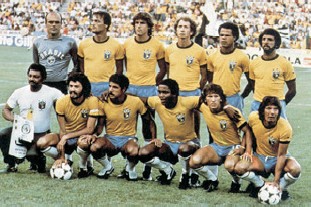
This started out being about Zico, probably the most talented individual of the Brazilian team from the 1982 World Cup in Spain. But I kept wandering away from him and his long and glittering career just to talk about that team, the wonder of its performances in that World Cup, and how it shaped the way I see football, the World Cup itself and all Brazilian teams, indeed, all teams, since.
The best team doesn't always win in football, especially in World Cups. This is a cliche which is usually backed up by a few references : Hungary in 1954, Holland in 1974, and Brazil in 1982 (we might add Argentina in 2006 to that list, but thats another post). Italy beat Brazil in 1982 in one of the best matches ever played. With Brazil out of the way, the Italians went on to win the tournament. But ask a football fan about that World Cup, and probably their first and favourite memory will be of the Brazil team.
First of all, it had a list of players of a stupidly high standard : besides Zico, there were Socrates, Falcao, Eder, Junior, Cerezzo, Oscar, Leandro and Serginho. If the majority of Brazilian internationals have an almost flawless technical ability, then this team set a standard none has since matched. They were all capable of changing a game with a piece of trickery, a cannonball from outside the box, a cunning, disguised pass, a sly dummy. Coach Tele Santana believed fervently that football was entertainment, and drilled his teams to play exciting, attacking football. This team was the epitome of that philosophy - built only to attack, to play forwards relentlessly. One of its greatest offensive weapons was Junior, the classic model of the bucaneering full back.
This team won every match in its South American Qualification schedule, never an easy task. Then, on a European tour in 1981, they beat England, France and Germany, each on home ground. In their final warm up match before the tournament, they beat Ireland 7-0 in Brazil. If ever there was a footballing equivalent of the Harlem Globetrotters, here it was. They didn't really do simple goals, either. This is Eder's winner from Brazil's first game in the World Cup proper, a 2-1 victory over the USSR. Observe the passing and movement in the build-up, Falcao's sublime little dummy on the final pass, and the fact that Eder doesn't just hit it,he flicks the ball up into the air just so he can volley it, same-footed( and past an utterly static Dasaev, at that time the best golakeeper on earth), into the top corner :
Eder was the team's left-winger, sometime taker of free-kicks (he sent one around the wall against Scotland at what looked like a right angle) when Zico didn't fancy it, and he was nicknamed "The Cannon" for the incredible power of his shooting. Brazilians have the coolest, most fantasy football names, too, and his full name is perfect for a South American footballer : Eder Aleixo de Assis. It seems incredible to say that for a player of such flair and skill, he wasn't even anywhere near being the star of the team.
But then he had competition. Zico ( real name : Arthur Antunes Coimbra, nickname : Galinho, or the Little Rooster, and no I don't have a clue why, it must be a Brazilian thing) was arguably the greatest player in the world in the era between Crujiff and Maradona, an attacking midfielder with an eye for spectacular goals, fantastic dribbling ability and a great range of passing. His free-kicks were all about elegance where Eder's were about power. Zico stroked the ball unerringly into the top corner, as if the wall wasn't there, as if the goalkeeper never had a chance. Go to Youtube and do a search, there are some unbelievable Zico compilations on there. This goal from 82 isn't even one of his best :
Then there was the team's captain, Socrates, cult hero whose face adorns t-shirts you can buy at Spitalfields and in Urban Outfitters. His full name is too big for brackets : Sócrates Brasileiro Sampaio de Souza Vieira de Oliveira. I'm not making this up. He was a qualified medical Doctor, held a doctorate in philosophy and smoked and drank heavily. While also being Captain of the best football team on earth and one of the best midfielders in the world. On the pitch, he tottered about like some Sunday morning park footballer, but his reading of the game was unerring, and his touch was always graceful, his decsion-making seldom wrong. He was particularly famed for his regular back-heels, which were always casual and yet always precise. He also cropped up occasionally with a crucial goal :
Then there was Falcao (relatively uninterestingly named plain old Paulo Roberto Falcao), Zico's partner in midfield, an elegant playmaker, driving force behind the Serie A winning Roma team of the mid-80s, and owner of that most crucial of 1980s footballing hairstyles, mullets excepted : the Ginger Afro. Thats him, on the right, the other chap is Zico :

Like everyone on that team, Falcao sometimes liked to blast one into the top corner from 30 yards. This one, for instance, from the afore-mentioned classic against Italy :
Junior, the teams left-back (full name : Leovegildo Lins da Gama Júnior, nickname : the Helmet, nope, don't ask me, mate) didn't seem to understand what a defenders job actually was. He spent most of his time skinning his opposing full-back and arrowing towards goal. Here he scores against Argentina :
That collection of talent somewhat overshadowed Serginho, the centre-forward, who was almost a British-style player, aggressive and powerful, used to niggling opposing defences into errors. If this team had any flaws offensively, then they were in the forward line. Serginho's game wasn't really suited to the pure football played by Santana's side. Indeed, he was only playing because of an injury to the first choice striker, Careca, a more cultured player. But the others had enough firepower to outgun any opponents, or so it seemed in the early rounds of the competition, when they dismissed the USSR 2-1, beat Scotland 4-1, and New Zealand 4-0. If those results made them appear flat-track bullies, well, then they beat an Argentina side featuring a young Diego Maradona (who was sent off for striking out in frustration) 3-1.
On July 5th 1982 they faced Italy at the Sarria Stadium in Barcelona. The World Cup was a very different competition back then, with two group stages before the knock-out stuff began at the semi final stage. Against Italy, Brazil only needed a draw. If they got that they would face a Poland side denied Boniek, its leading player, in the semi-finals. Italy were still struggling for form, having drawn their three group games against Poland, Peru and Cameroon. They only qualified for the second group stage on goal difference. Once there they had beaten Argentina, mainly because their hard-as-nails defender Claudio Gentile had kicked Maradona all over the pitch, recording a World Cup record for fouls on a single player. The rest of his teammates had taken his example and Argentina were bullied out of their rhythm and the competition. Italy were not talking to their national press. Star striker Paolo Rossi, just returned to the game after a long ban for his involvement in a match-fixing scandal, was misfiring, yet to score or even play well. It seemed like a formality that Brazil would win.
But what made this Brazilian team such a joy to watch was their commitment to constant attacking football. Here it would prove their undoing. Italy, as always, could defend as strongly as anyone in World football. They played on the counter-attack, and within 5 minutes they were 1-0 ahead, Rossi finally coming good with an easy header. Brazil equalised through Socrates before Rossi scored again, a shot from the edge of the box exposing the weakness of the Brazil keeper, Valdir Peres.
Again, Brazil came back,and I remember watching the second half of the match, with Brazil dominating, threading the ball around the pitch, shooting every few minutes, then the Italians retaliating with their own lightning-quick breaks. It was football of a quality I had never seen before, football like something from a modern computer game. These men in yellow shirts played a different game to the players I regularly saw in the English league. Even their kit seemed more galamourous and beautiful than the usual red and white and blue and white combinations I knew so well. It has been claimed that part of the spell that the World Cup-winning Brazilian team of 1970 cast upon the World's population was down to the fact that 1970 was the first televised World Cup and the Brazilian kit - golden shirts and a gleaming, metallic blue for the shorts - looked so glorious in full colour under the Mexican sun on television screens across the planet. As a young boy I fully understood that in some instinctive way - football kits were important totems, the colours and combinations seemed to have some power and meaning I felt but would never have been able to articulate. Brazil had the best team and the best kit. Against Italy (whose Italian nickname, the Azurri, even comes from the colour of their shirts), their football finally paid off as Falcao equalised in the 68th minute. Its that goal from up above, and you can see how important it was from his mental celebratory sprint across the pitch.
But Rossi wasn't to be denied. If Italy had done enough to qualify they would have retreated, protected their own goal. Not Brazil. They kept attacking, looking for more goals. In the 74th minute, Italy forced a corner and Rossi scored after a scramble on the edge of the area. Brazil attacked frantically for the remaining 15 minutes - and had a series of glorious chances - but Rossi's hat-trick had finished them off, and the game ended 3-2 to Italy. Brazil were out and Santana resigned.
The spine of that team returned for the 1986 World Cup, but Zico, Junior, Falcao and Socrates were all 32 and over, and they never played to the same high standard. They were eliminated (in another classic, and on penalties) by Platini's France in the Quarter-finals. It would be 1994 before Brazil would again win the World Cup, and they did so playing a relatively dour, defensive brand of football. The legendary status of the 1982 team, despite its lack of success, remains undimmed.
The 2006 Brazilian side, blessed with its purportedly dazzling attacking line-up including Ronaldinho, Ronaldo, Kaka, Robinho, Adriano and Juninho, was compared to the 1982 team in the run-up to a World Cup they were favourites to win. But they never gelled, they never even really entertained, and as a team, they don't even deserve to be mentioned in the same breath. Brazil 1982 seem to me to be the best team I ever saw, playing football the way its supposed to be played. Still, I suppose the 2006 team had a couple of decent players. This chap, for instance. Zico himself would be proud of a goal like this :
Thursday, December 14, 2006
Liam Brady

Liam Brady may well be the greatest Irish footballer ever. There is a small pool of contenders for that title, perhaps four once we exclude George Best on the grounds that he was from Northern Ireland, and not the Republic.
There is Liam Brady, and there are Roy Keane, Paul McGrath and Johnny Giles. Brady was probably the most skilled of the four, perhaps the only true magician to ever play in the Ireland team. Gifted with a sublime left foot, Brady was a creative midfielder, a Number 10 who actually played wearing Number 7, and the talisman for Ireland, Arsenal and Juventus in the late 70s and early 80s.
He went to the same school as me (as did the current Irish Prime Minister) but when I attended, the rumour always was that Brady, easily the pupil's favourite past-pupil, had been expelled. It was a Christian Brothers School, very seriously G.A.A (meaning it enthusiastically promoted Gaelic games and tried to dissuade pupils from playing "English" games like soccer), and back in the 60s and 70s, that may even have resulted in disciplinary measures being taken against anyone who preferred to play football over Gaelic Football or hurling. But Dublin is a city in love with football, and in the 60s and 70s it produced a stream of players who thrived once they had moved to England. Brady came from a strong football family - his brothers played for QPR and Millwall, and his uncle had played - and was spotted by an Arsenal scout playing for St. Kevins Boys, a Dublin schoolboy institution. He signed for Arsenal in 1970, aged 15, and made his first-team debut at 17.
His game was built on his passing. He had a lovely first touch, and he was one of those midfielders who never seemed rushed, who always seemed to find himself in space, and who rarely gave the ball away. His long passing was as good as his short, and altough he obviously favoured his left foot, he did not really have a weak foot - he could pass and shoot with his right too. His skill demanded that every move passed through him and so he dominated games. Irish players generally possess a combatativeness and hunger in the challenge that helps them settle quickly in the British game, and Brady was no different. Though he had a slight build, he was sharp in the tackle, nipping the ball off opponents and covering a lot of ground for a ball-playing midfielder. He was the best player in an otherwise mediocre Arsenal side between 1974 and 1980, and was voted PFA player of the year in 1979, the same year in which Arsenal won the FA Cup, beating Man Utd 3-2 in a famously thrilling final. Brady, or "Chippy" to his teammates, started the move that led to the winning goal, of course.
He is also fondly remembered by Arsenal fans for this goal, scored against Spurs in a 5-0 win, typical of his class and mastery, but also illustrating his nice tackling :
But he grew tired of what he perceived as Arsenal's lack of ambition. In 1980, Arsenal played Juventus in the semi-finals of the Cup Winners Cup, and Brady enjoyed what he later called his greatest ever game in Turin, where the Italians were defeated 1-0. In the first leg at Highbury, Marco Tardelli had been sent off for repeatedly fouling Brady. Arsenal lost on penalties to Valencia in the final, but Juve had been impressed enough to buy him for £600,000 and make him one of their first foreign signings after the Italian game was opened up to imports. Brady had almost joined Man Utd for £1.5 million, in what would have been a British record transfer, but he felt he needed a new challenge beyond the English game.
At the time it was unusual for British or Irish players to go abroad, but it is indicative of Brady's class that a club of Juventus' stature was interested in him and of his intelligence that he was so eager to go. The only recent English player to succeed on the continent had been Kevin Keegan, who had led Hamburg to a Bundesliga title and European Cup Final. But the German game resembled the English game in its pace and physicality, whereas the Italian game was slower and more tactical. Brady may have suspected that given the technical quality of his style, he would fit in perfectly.
He quickly became Juventus' key player and pivotal to them winning the Serie A title for two consecutive seasons, scoring 13 goals in his 57 games. Near the end of the 1982 season, there were rumours that Michel Platini was to be the clubs big Summer signing, and given that he played in the same position as Brady - and even had a similar style - and that his presence would mean there were more than the Italian limit of 2 foreigners at the club, Brady feared for his future. He was informed that he would be sold in the close-season, but even with this knowledge, Brady took the crucial penalty in the final game of that season away to Cantanzaro and Juventus won 1-0, pipping Fiorentina to the title by a single point.
Brady moved on, first to newly-promoted Sampdoria (82-84), then to Inter Milan (84-86) and Ascoli (86-87). He finally returned to London to play for West Ham until injury forced him to retire in 1990. In Italy, he is remembered as one of the best foreign imports ever to play in the country, and one of the few players from the British Isles to succeed in the Italian game.
He was unlucky to play for Ireland during a long poor spell for the teams international fortunes. Despite the quality of players Ireland exported to the English game, the Irish team was forever narrowly missing out on qualification to the Major tournaments, generally at the hands of a bigger Football Nation. Twice in the 1970s, once with Brady in the side, Ireland were closely eliminated by the USSR. For the 1982 World Cup Qualifiers, Irelands group included Platini's France, a Holland in the process of rebuilding, a young and dangerous Belgian team and Cyprus. But this was possibly the greatest ever Irish team in terms of sheer talent, with players from most of England's major clubs represented, including the likes of David O'Leary, Frank Stapleton, Ronnie Whelan, Kevin Moran, Paul McGrath, Mark Lawrenson and Tony Galvin, all of whom played for either Man Utd, Arsenal, Liverpool or Spurs. Ireland lost two matches in that group, one of those a 1-0 defeat in Brussels when a goal was controversially disallowed, the other in Paris. The final match was against France at Lansdowne Road and Ireland won an amazing game 3-2, only to miss out on qualification to the French on goal difference. That French side would reach the semi-finals in Spain and two years later became European Champions.
When success finally did come to the Irish team, Brady was reaching the end of his career. He played in the qualifiers for the 1988 European championships, but his relationship with new manager Jack Charlton was strained. Charlton liked his Ireland side to play a pressure game, pumping long balls directly towards tall strikers and constantly harrassing the opposition when they had the ball. It was ugly, but it worked against continental teams who were used to being given time and space to play their football. But it wasted Brady's talent for moving the ball fluidly and imaginitively and for bringing his teammates into the play. Nonetheless, Brady was too great a talent for Charlton to ignore, and he played in the qualifiers until his way with a sharp tackle got him sent off in the final game against Bulgaria, earning him a suspension for the first two games of the tournament. As it happened, Brady was injured playing for West Ham shortly afterwards, and his injury would have ruled him out anyway. He played his last game for Ireland in a friendly against West Germany in 1989, before qualification for the 1990 World Cup had been secured. There was always the sense that Charlton was glad to see the back of him, and indeed he substituted him early in that match, for which Brady bitterly resented him. Its a horrible irony - and not unlike that of George Best with Northern Ireland - that Ireland's greatest ever talent never got to play for his country in the greatest tournament.
But he was the country's most successful footballer before Roy Keane, and the first to succeed on the Continent, where so many others from the British game would fail. He also scored this winning goal, his ninth in his 72 internationals, against Brazil in Dublin in 1987. I was at that match, and even then there was a sense that he was the best we had ever had, and maybe would ever have, and the crowd celebrated this goal accordingly :
Tuesday, November 21, 2006
Michael Laudrup

The World Cup in Mexico in 1986 was the first one I was really old enough to appreciate. I have memories of Spain in 1982 - I watched at least one of Northern Ireland's matches and the Brazil-Italy game, probably the best game I'll ever see though I wasn't to know it then. But I was seven in 1982, and though I liked football, it wasn't quite a passion in the way it became in subsequent years. By 1986 I was hooked. 1986 was the first time I bought a Panini sticker album - we filled it, my brother and I - and the first time I read about foreign teams before the tournament. I knew who Ruminegge was. I knew Platini and Boniek and Zico. I had some idea of which teams were expected to do well in the competition. There were a few players from my club involved - Bryan Robson and Norman Whiteside - and I wanted them to do well. 1986 is probably also the year my love of Argentinean football began, with Maradona's incredible genius.
I knew Denmark before the tournament. They had been in Ireland's qualification group and had beaten us - handily - 3-0 in Copenhagen and 4-1 in Dublin. They had an exciting attack-minded team, fluid and full of movement and with goals coming from all across their midfield and forward line. They were fresh from appearing in the semi-finals of the 1984 European Championship, where they went out on penalties to Spain. Their fans were fantastic and not unlike Ireland's would be some years later - loud and colourful and seemingly just happy to be there. They called their team "Danish Dynamite". Their forward pairing was the most explosive element of that team. The experienced Preben Elkjaer led the line aggressively, winning high balls and chasing down defenders. Supplying the guile and vision was young Michael Laudrup.
Denmark had been drawn in their first World Cup in the "Group of Death". Every tournament has one - a group with no obviously weak team. This time the other three teams were Germany, Uruguay and Scotland. Denmark could expect to come maybe third out of that group, behind the ever-impressive Germans and Enzo Francescoli's Uruguay.
But Denmark won the group, at a stroll. They beat all of the other teams, including a 6-1 thrashing of Uruguay featuring this goal by a then 22-year old Laudrup :
That match was on past my bedtime, probably. During that summer I would get up and watch highlights of football matches played at 1am the previous day. Thats was how I saw that goal and became aware of Laudrup. That was also how I became aware of Denmarks departure from the tournament, beaten again by Spain, 5-1. But that Laudrup goal against Uruguay made a big impression on me. I loved dribblers back then. It seemed to me to be the way football should be played. Get the ball, beat a man with a feint, beat another with a jink, do it again. So obviously, Maradona was a god to me. But that World Cup introduced me to some other great playmakers from less fashionable countries than Argentina - Laudrup from Denmark and Enzo Scifo from Belguim.
Laudrup could dribble brilliantly, of course, his ability to flick the ball from one foot to the other with equal dexterity baffling a succession of defenders, but his game was based more on his ability to pick out an outstanding pass. His first European exposure came when Juventus signed him from Brondby in 1983 and immediately loaned him out to Lazio. He had been bought probably as a replacement for Michel Platini, but Platini was in the peak form of his career, and eventually Laudrup was brought back from his loan period - after two years - to play alongside the Frenchman in place of Boniek. Juventus have a reputation for playing powerful, efficient football and Italian pragmatism usually only accommodates one playmaker, but the Platini-Laudrup combination won Serie A in 1986. When Platini did retire in 1987, Laudrup was unable to dominate games the way his illustrious predecessor had done and Juventus had a couple of years without the success the club was accustomed to.
When Johann Cruijff took over as Coach of Barcelona he set about building his so-called "Dream Team". Only three foreign players could play at any one time alongside homegrown players such as Pep Guardiola and Goikoetxea. Cruijff placed the temperamental Bulgarian striker Hristo Stoichkov up front, with the cultured Ronald Koeman in defence. In between he needed a player who recalled his own playing style, somebody to pull the strings and make things happen. Laudrup was such a player. The Dream Team lived up to its nickname, winning La Liga four times consecutively between 1991-1994 and winning Barcelona's first European Cup at Wembley against Sampdoria in 1992. To bolster an already strong team Cruijff bought Romario, and he and Laudrup struck up an immediate partnership, Laudrup supplying the ammunition for the Brazilian's unfaltering finishes. Romario called Laudrup the best player he ever played with, and with characteristic modesty, said that he was the 5th best player of all-time, behind Pele, Maradona, Romario himself and Zinedine Zidane. This pass is something of a Laudrup trademark, since perfected by Ronaldinho - the player looks one way and moves the ball the other :
However, the presence of three such high-profile foreigners in Barcelona's ranks meant that the three had to be rotated. Laudrup was left out of the starting line-up against AC Milan in the European Cup final in 1994, Barcelona lost 0-4, and Laudrup left, moving controversially to Real Madrid. In his first season Madrid won La Liga, ending Barca's period of dominance. Laudrup would only stay for one more season but impressed Real's fans and players so much that he was voted the 12th best player ever to play for the club by Marca in 2002. Raul called him the best player he has ever played with, above the likes of Zidane, Figo, Redondo and Ronaldo. When he left Madrid he floated for a while, playing in Japan and for Ajax before retiring.
If he had been born in South America or in one of Europe's traditional football powers, then Laudrup would be held in higher regard than he is. He was the classic Number 10, exceptionally technically gifted, a great passer, dribbler and capable of fabulous long-range shooting. Platini once praised him as one of the most talented players in the history of the game, lamenting only his lack of selfishness which meant that he scored too few goals. But there is something intrinsically Scandinavian in Laudrup's love of an assist, his appreciation of his team-mates, and ability to find them with some seemingly impossible balls.
He did not help himself in terms of how posterity views him : In 1992 he was involved in a dispute with the Danish coach, Richard Moller Nielsen, over the teams tactics, and quit during qualification. When Denmark were summoned at the last minute to replace a disqualified Yugoslavia at the European Championships in Sweden, his younger brother, Brian, also a gifted playmaker, took Michael's position as Denmark won the tournament, shocking Holland and Germany to do so. When he returned to the Danish squad, they failed to qualify for the 1994 World Cup and were eliminated early from Euro 1996. In France in 1998, Laudrup enjoyed a last hurrah on the international stage, playing as Captain alongside his brother as Denmark reached the quarter-finals where they were eliminated narrowly, 3-2, by finalists Brazil.
The game before that, where Denmark had routed a fancied Nigeria side, featured two typical examples of Laudrup's vision and unselfishness in the passes for the first and third of Denmark's goals, and is a good clip to finish with :
Subscribe to:
Posts (Atom)